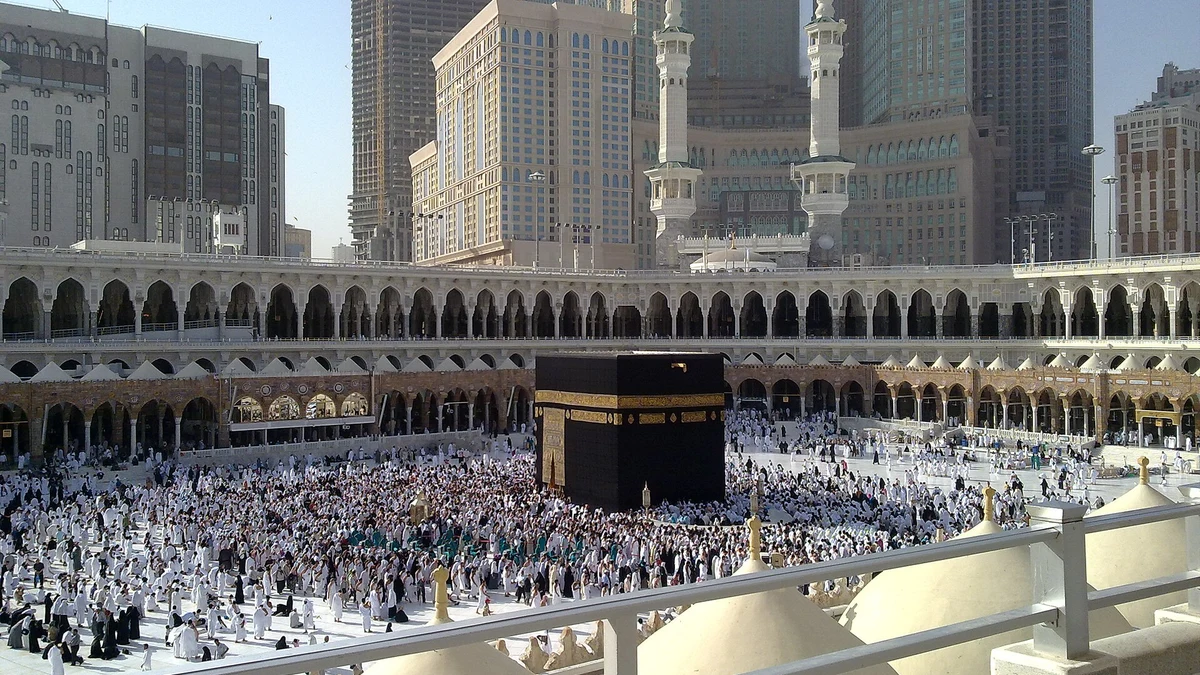
How to perform Umrah comes down to four rites performed in order: entering ihram, Tawaf around the Kaaba, Sa’i between Safa and Marwah, and cutting the hair. The rites themselves take a few hours. Understanding them properly is what turns those hours into worship rather than anxious imitation of the person in front of you.
This step-by-step guide is written for pilgrims travelling from the UK. It covers preparation before you fly, the miqat crossed in the air, every stage of the rites with what to recite and what is not established, how the steps differ for women, what to do with children, and the mistakes that cause most confusion at the Haram.
Where scholars differ, that is stated rather than hidden. Where a widespread practice has no established basis, that is said too, because pilgrims deserve to know the difference between an obligation and a custom.
The steps of Umrah at a glance
Here is the whole sequence before we look at each stage in detail.
| Step | What you do | Where |
|---|---|---|
| 1. Ihram | Wash, dress, make the intention | At or before the miqat |
| 2. Talbiyah | Recite aloud until Tawaf begins | From the miqat onwards |
| 3. Tawaf | Seven circuits, Kaaba on your left | The Mataf, Masjid al-Haram |
| 4. Two rak’ahs | Pray behind Maqam Ibrahim if possible | Anywhere in the mosque if crowded |
| 5. Zamzam | Drink to your fill with intention | Dispensers throughout the mosque |
| 6. Sa’i | Seven lengths, Safa to Marwah | The Mas’a gallery |
| 7. Halq or Taqsir | Shave or shorten the hair | Barbers near the Haram |
The two counts that matter. Tawaf is seven circuits, starting and finishing at the Black Stone corner. Sa’i is seven lengths, starting at Safa and finishing at Marwah. Almost every anxious question at the Haram is really about one of these two counts.
First-Time Umrah: Check Before Moving On
The official Nusuk journey guide groups Umrah into ihram, Tawaf, Sa’i and hair cutting. Longer seven-step checklists often separate arrival, prayer and Zamzam into their own steps; that does not make every item an identical religious obligation.
- Before miqat: confirm whether your route goes to Makkah or Madinah first, have the appropriate clothing ready, and enter the rite before crossing the boundary towards Makkah.
- Before Tawaf: settle questions about purity with your guide, identify the Black Stone corner and agree who will help keep count. You do not have to touch the Stone through a crowd.
- After Tawaf: confirm seven completed circuits before moving on. Find a safe place for the prayer rather than blocking the flow behind Maqam Ibrahim; read the detailed section below for the sequence.
- During Sa’i: Safa to Marwah is one length and the return is the second. The seventh finishes at Marwah, not back at Safa.
- Before changing out of ihram: complete the appropriate hair cutting after Sa’i. Reaching the hotel or finishing Tawaf alone does not release you from ihram.
If you use a wheelchair or travel with someone who needs help, agree a counting method and a meeting point before entering the busiest areas. Rest and assistance should be planned around the rite, not treated as a race against another group’s finishing time.
What is Umrah?
Umrah is a visit to the Sacred House in Makkah involving a defined set of rites. Unlike Hajj it can be performed at any time of year and takes hours rather than days.
Its standing in Islam
The Quran instructs believers to complete both Hajj and Umrah for Allah in Quran 2:196. The Prophet ﷺ said that one Umrah to the next is an expiation for what lies between them, reported in Sahih Muslim 1349.
Is it obligatory?
Scholars differ. The Shafi’i and Hanbali schools hold Umrah obligatory once for those able; the Hanafi and Maliki schools treat it as a confirmed Sunnah. Our comparison in difference between Hajj and Umrah sets this out fully.
Learn the rites before you fly. Reading this at home, calmly, is worth far more than trying to absorb it while standing in the Mataf surrounded by thousands of people.
The virtue and reward of Umrah
Knowing why you are performing these rites changes how you perform them, so it is worth establishing before the mechanics.
Expiation between one Umrah and the next
The Prophet ﷺ said that one Umrah to the next is an expiation for what lies between them, and that an accepted Hajj has no reward less than Paradise. This is reported in Sahih al-Bukhari 1773.
Pilgrims as a delegation
Those performing Hajj and Umrah are described as a delegation to Allah who answer His call and are answered, reported in Sunan Ibn Majah 2893. That should produce hope rather than complacency.
Removing poverty and sin
Performing Hajj and Umrah in succession is described as removing poverty and sins as a furnace removes impurity from metal, reported in Jami’ at-Tirmidhi 810.
What this means practically
It means the rites deserve attention rather than being hurried through so the trip can move on to shopping. A pilgrim who performs one unhurried, understood Umrah has done better than one who completes three while distracted throughout.
Set your intention before you leave home. Decide what you are asking for and who you are asking on behalf of while you are still in the UK. It is remarkably hard to think clearly for the first time while standing in front of the Kaaba.
Preparing before you leave the UK
Most difficulties during Umrah trace back to something that should have been settled in Britain.
Learn the sequence
Know the four rites and their order. You do not need to memorise long supplications, but you should know what comes next without asking.
Pack the practical items
Two ihram sets for men, unscented toiletries, comfortable sandals, a shoe bag and a money belt. Our guide to ihram rules lists what is restricted once you enter the state.
Sort permits and paperwork
Check permit arrangements through the official Nusuk platform; entry permission is a separate requirement. Read the current GOV.UK entry requirements before fixing your travel plans.
Practise wrapping ihram at home. Twice is enough. Attempting it for the first time in an aircraft toilet is a genuinely common and entirely avoidable stress.
Step 1: Entering ihram
Ihram is the sacred state, not the clothing. It begins with the intention, and everything else follows from that.
The Sunnah preparations
Perform ghusl, trim the nails, remove unwanted hair and apply perfume to the body but never to the cloths. All grooming must be done before entering the state, because it becomes restricted afterwards.
The clothing
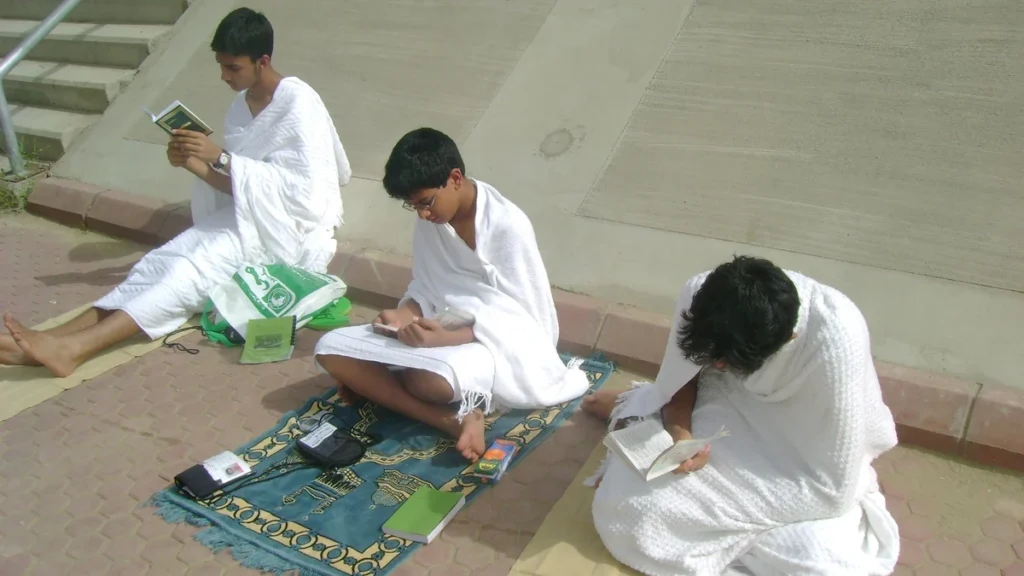
Men wear two unstitched cloths: the izar around the waist and the rida over the shoulders, with the head uncovered. Women wear ordinary modest clothing with the head covered and no fitted face veil or gloves.
The miqat for UK pilgrims
Flying direct to Jeddah, you cross the miqat in the air. Enter ihram before that crossing, not after landing. The boundaries were designated by the Prophet ﷺ as recorded in Sahih al-Bukhari 1524.
If your trip begins in Madinah, the miqat is Dhul Hulayfah, known today as Abyar Ali. Coaches stop there; the Haramain train does not.
Do not rely on the announcement. Cabin announcements are missed, delayed or made only in Arabic. Know your flight time and enter ihram comfortably ahead of the crossing.
The intention and the Talbiyah
The intention is an action of the heart. There is no long formula that must be pronounced.
Making the intention
Know in your heart that you are entering Umrah. Many pilgrims say a short declaration such as “Labbayka Umrah”. That is sufficient; nothing more elaborate is required.
Reciting the Talbiyah
Begin the Talbiyah aloud and continue reciting it frequently until you start Tawaf. Men raise the voice; women recite audibly to themselves. The full Arabic, transliteration and meaning are in our duas for Umrah guide.
When the Talbiyah stops
You stop reciting the Talbiyah when you begin Tawaf. This is a small detail that pilgrims frequently ask about at the Haram.
Arriving at Masjid al-Haram
Entering the mosque for the first time is the moment most pilgrims remember for the rest of their lives.
Entering with the right foot
Use an entrance open to your group and follow the stewards’ directions. Enter with your right foot and read the mosque-entry supplication in Sahih Muslim 713a. Do not push towards a particular gate or treat its name as a condition of a valid Umrah.
Seeing the Kaaba
There is no single authenticated fixed dua for the first sight of the Kaaba. Supplication at that moment is encouraged, so ask for what matters to you in whatever language you understand.
Prepare your dua list before you arrive. Emotion at the first sight of the Kaaba empties most people’s minds entirely. A short written list of names and needs means nothing important is forgotten.
Step 2: Performing Tawaf
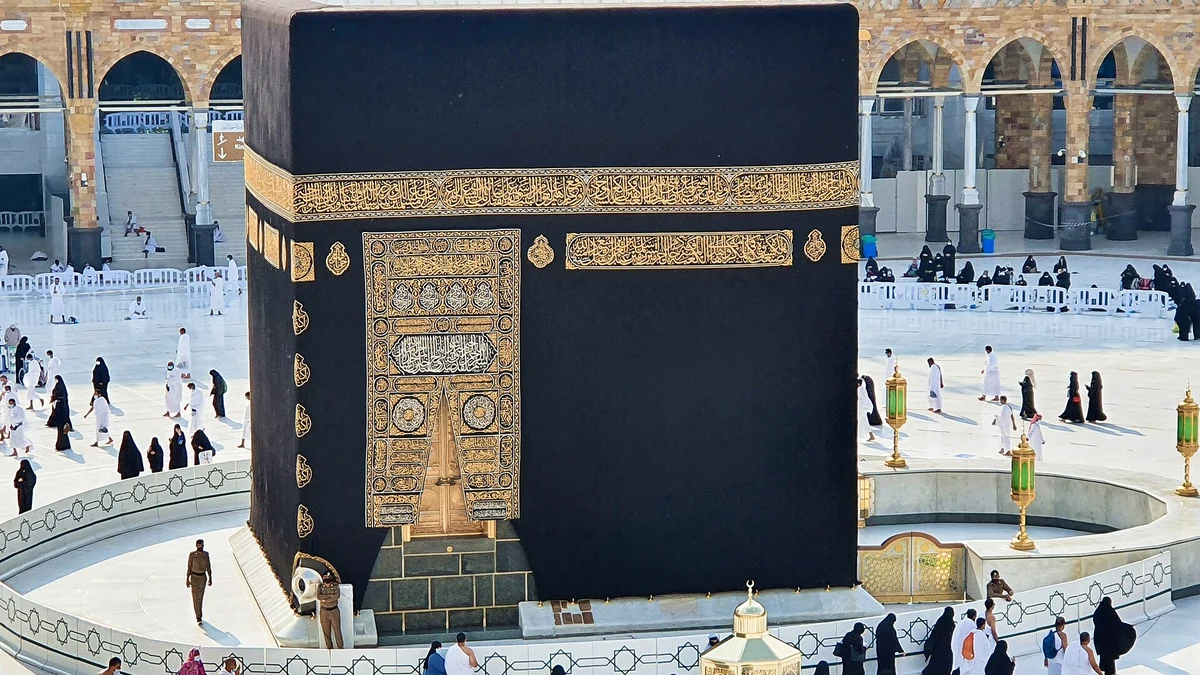
Tawaf is seven complete circuits of the Kaaba, performed anticlockwise with the Kaaba on your left.
Where to start and finish
Each circuit begins and ends at the Black Stone corner. A green light and a floor marking indicate the line. Face the stone, say “Allahu Akbar”, and begin.
Greeting the Black Stone
If you can touch or kiss it without harming anyone, that is the Sunnah. If you cannot, simply point towards it with your right hand and say “Allahu Akbar”. Umar reported the Prophet’s practice with the stone in Sahih al-Bukhari 1597.
Pushing through a crowd to reach it is not required and causes genuine harm. The pointing is entirely sufficient.
Idtiba and Raml
For men, idtiba means passing the rida under the right arm so the right shoulder is bare, and this applies during Tawaf only. Raml means walking briskly in the first three circuits, reported in Sahih al-Bukhari 1644. Neither applies to women.
What to recite during Tawaf
There is no fixed dua prescribed for each circuit. Printed cards assigning a specific supplication to each round are a custom, not an established Sunnah. Recite Quran, make dhikr and ask for what you need.
Between the Yemeni Corner and the Black Stone, the reported supplication is the verse asking for good in this world and the next, from Quran 2:201.
Count on your fingers. Losing count is the single most common Tawaf problem. Move a finger each time you pass the Black Stone corner. If you genuinely cannot remember, build on the lower number.
Where to perform Tawaf: the Mataf and the upper levels
Tawaf can be performed on several levels, and choosing the right one makes an enormous difference to how the rite feels.
The Mataf, at ground level
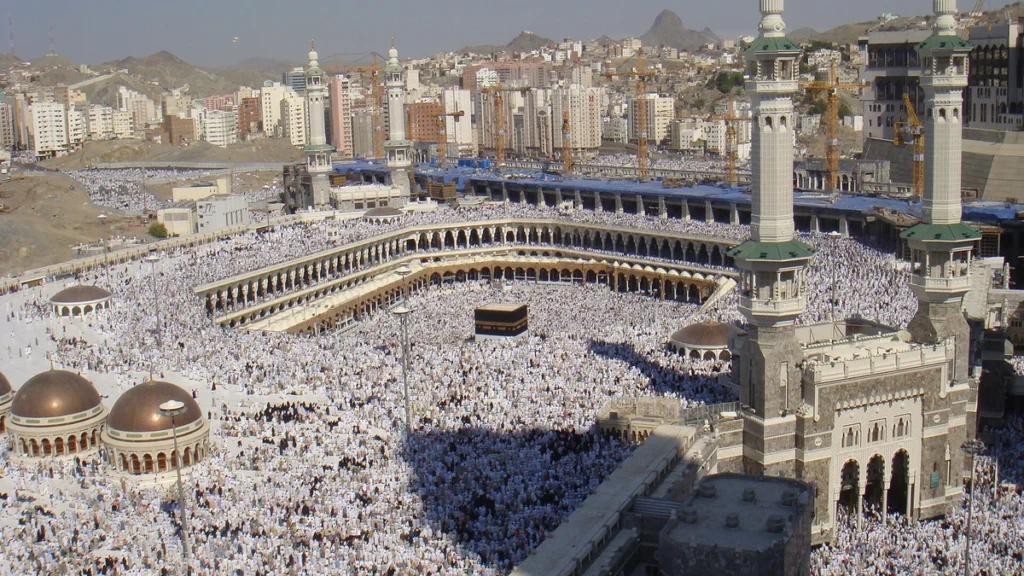
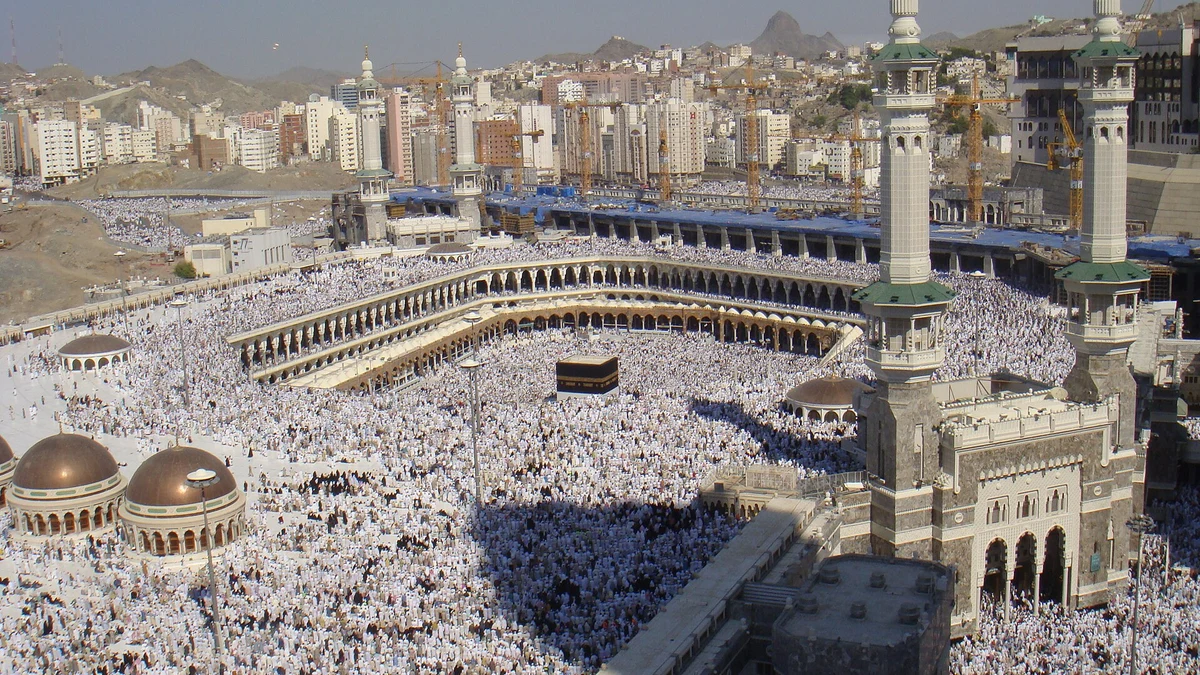
The marble courtyard immediately around the Kaaba. Circuits are shortest here, but it is by far the most crowded and is often closed or restricted at peak times.
The first floor and the roof
Circuits are considerably longer because the circumference is greater, but the space is calmer and the pace is your own. A Tawaf upstairs may take longer in minutes while being far easier in practice.
Wheelchair and mobility routes
Dedicated routes exist for wheelchairs, and chairs can be hired or pushed by an attendant. Performing Tawaf in a wheelchair is entirely valid.
Which to choose
If you are elderly, unwell, travelling with children, or performing Umrah during Ramadan, the upper levels are usually the better decision. Proximity to the Kaaba is not a condition of a valid Tawaf.
Longer circuits, calmer worship. Pilgrims often insist on the Mataf and then spend the whole Tawaf defending their position in a crush. A slower circuit upstairs where you can actually make dua is frequently the better choice.
After Tawaf: Maqam Ibrahim and Zamzam
Two short acts follow the seventh circuit.
Two rak’ahs
Pray two units behind Maqam Ibrahim if there is space, reciting the verse referring to it from Quran 2:125. If the area is crowded, which it usually is, pray anywhere in the mosque. Do not obstruct the Tawaf flow to stand in a particular spot.
Drinking Zamzam
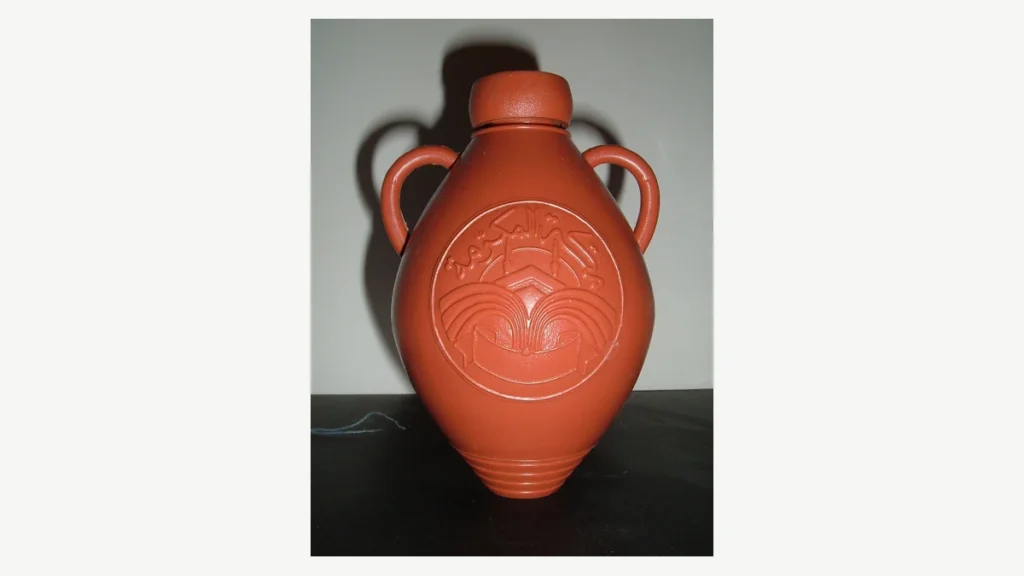
Drink Zamzam to your fill with a clear intention. The Prophet ﷺ said Zamzam is for whatever it is drunk for, reported in Sunan Ibn Majah 3062. Our guide to Zamzam water covers the Sunnah of drinking it.
Step 3: Performing Sa’i
Sa’i is seven lengths between the hills of Safa and Marwah, retracing Hajar’s search for water for her son.
Starting at Safa
Begin at Safa, reciting the verse naming the two hills as among the symbols of Allah from Quran 2:158. Face the Kaaba, praise Allah and make dua.
Counting the seven lengths
Safa to Marwah is one. Marwah to Safa is two.
Continue in this way, and the seventh length finishes at Marwah, not back at Safa. This is the detail pilgrims most often get wrong.
The green lights
Men hasten between the two green markers; women walk normally throughout. The origin of Sa’i in Hajar’s search is narrated in Sahih al-Bukhari 3364.
What to recite during Sa’i
As with Tawaf, no fixed supplication is prescribed for each length. Make dhikr, recite Quran and ask for what you need.
The counting rule that prevents the most confusion. Seven lengths, not seven return journeys. You begin at Safa and you finish at Marwah. If you end back at Safa, you have done eight.
Step 4: Shaving or shortening the hair
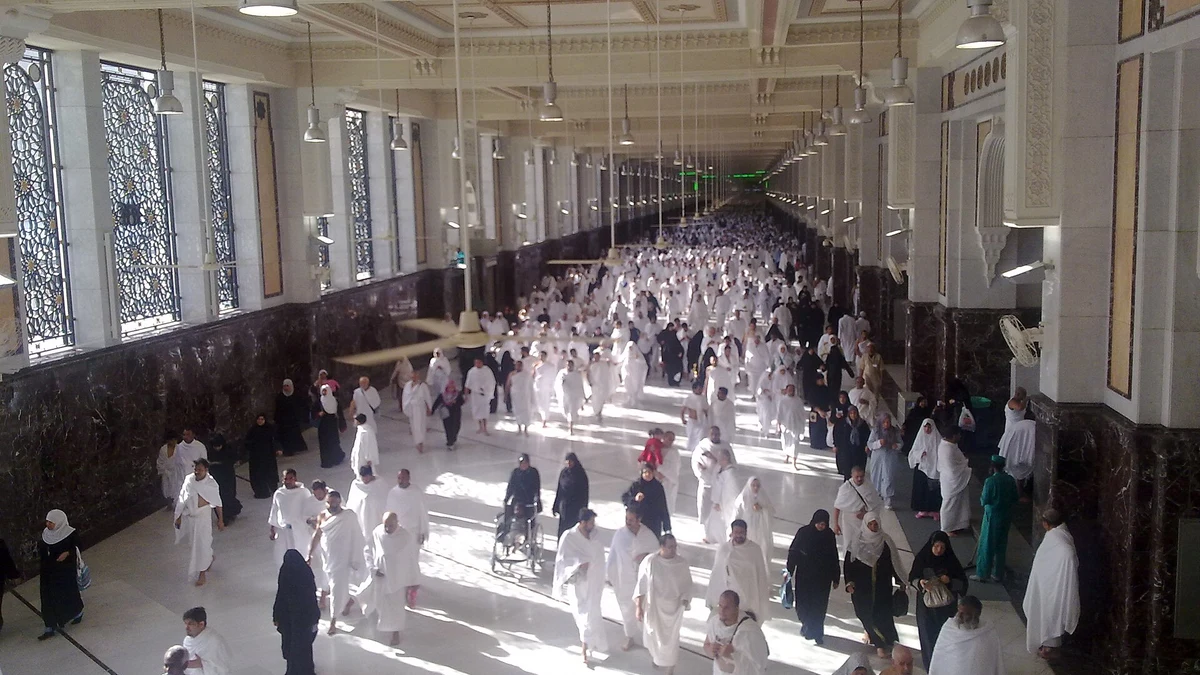
The final rite releases you from ihram.
For men
Shave the head completely, known as halq, or shorten the hair all over, known as taqsir. The Prophet ﷺ supplicated for those who shaved, reported in Sahih al-Bukhari 1727. Follow the hair-cutting requirements of the school you follow; do not rely on a token snip without guidance.
For women
Gather the hair and cut approximately a fingertip length from the end. Women do not shave the head.
The most common last-minute error. Snipping a few strands from one side is not sufficient taqsir. Take from all around the head, or use one of the barbers near the Haram who do this all day.
Leaving ihram
Once the hair is cut, Umrah is complete and the restrictions lift. You may wear ordinary clothing, use perfume, cut nails and resume normal life.
It is worth pausing at this point rather than rushing straight out. Many pilgrims find the moment of completion passes without them noticing it at all.
Where the rites differ for women
The sequence and obligations are identical. A few specific practices are not.
| Practice | Men | Women |
|---|---|---|
| Sequence of rites | Identical | Identical |
| Clothing | Two unstitched cloths | Ordinary modest clothing |
| Head | Uncovered | Covered as normal |
| Raml, brisk early circuits | Yes | No |
| Idtiba, right shoulder bare | Yes | No |
| Hastening between green lights | Yes | No |
| Talbiyah | Recited aloud | Recited audibly to oneself |
| Ending the rites | Shave or shorten all over | Cut a fingertip length |
Clothing and voice
Ordinary modest clothing with the head covered, and the Talbiyah recited audibly to oneself rather than aloud.
Raml, idtiba and hastening
None of these apply to women. They walk normally throughout Tawaf and Sa’i.
Menstruation
A woman who is menstruating enters ihram and recites the Talbiyah normally but delays Tawaf until she is pure. This was the instruction given to Aisha, reported in Sahih al-Bukhari 1650.
Plan the itinerary with this in mind. Women whose cycle may fall during a short trip should discuss timing with their operator and a qualified scholar before booking, rather than discovering the problem on arrival.
Performing Umrah with children
Children are not obliged to perform Umrah, but many UK families bring them and the rites are valid and rewarded.
What children wear
Boys wear small ihram cloths; girls wear ordinary modest clothing. Child-size sets are far easier to buy in the UK than in Makkah.
Pace and practicality
Tawaf and Sa’i together cover several kilometres. Plan rest, water and a quieter hour of the day. A child who is exhausted and distressed is not gaining from being pushed through.
Keep them close
Agree a meeting point before you begin, and hold younger children throughout. The Mataf is extremely crowded at peak times.
If you need hotels and transfers planned around your group’s pace, ask our UK team for a written itinerary. Tell us about practical assistance you need before choosing a package.
If you are unwell or have limited mobility
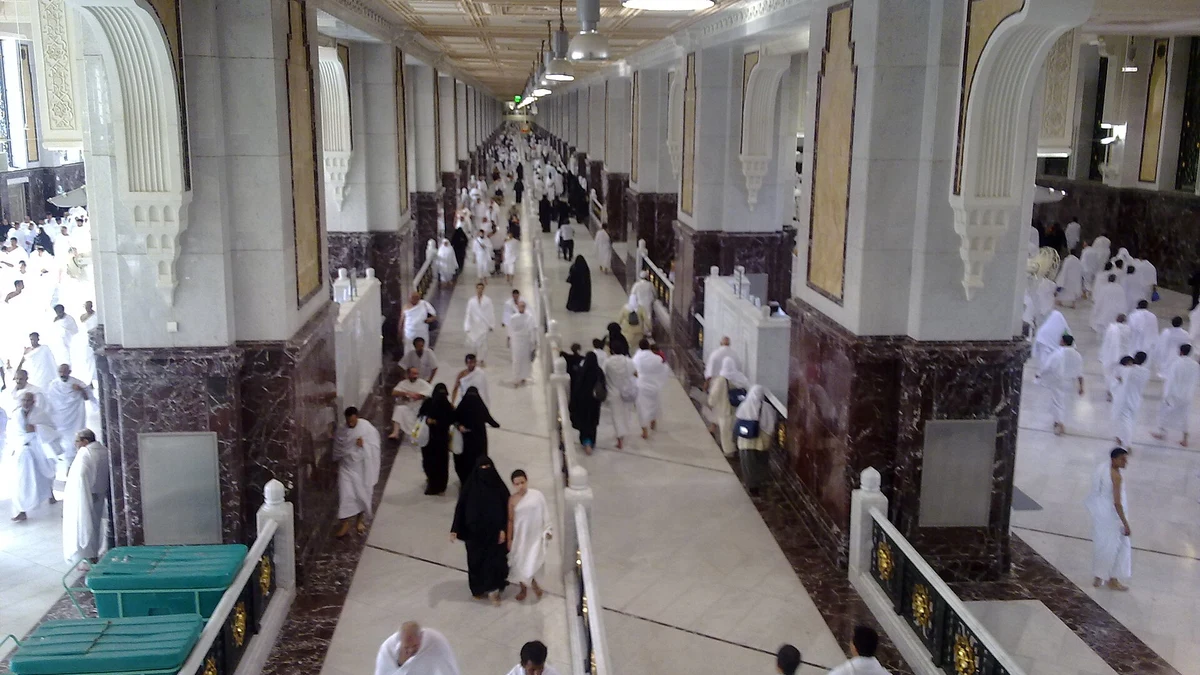
The rites accommodate genuine need, and pilgrims routinely restrict themselves more than required.
Wheelchairs and mobility assistance are available at the Haram, and both Tawaf and Sa’i may be performed using them. Medication may be taken, wounds dressed and medical devices worn. Where a restriction genuinely cannot be kept, Quran 2:196 provides for compensation rather than hardship.
Arrange assistance in advance. Tell your operator before departure if anyone in your group needs a wheelchair or a hotel close to the Haram. Check health guidance on TravelHealthPro before you fly.
Performing a second Umrah
Many pilgrims perform Umrah more than once in a single trip, often intending the reward for a relative who has passed away.
Each Umrah needs a fresh permit and a fresh ihram entered from outside the Haram boundary, most commonly at Masjid Aisha in Tan’im. Every restriction applies again in full.
Pace yourself honestly. Repeated Tawaf and Sa’i in heat is demanding. Exhausting yourself until you miss congregational prayers in the Haram is not an improvement on one unhurried Umrah.
If you make a mistake in the rites
Almost every pilgrim worries about this, and almost every case is straightforward to resolve.
Losing count
Build on the number you are certain of. If you cannot recall whether you completed four circuits or five, treat it as four and continue. Certainty is the basis; doubt is set aside.
Breaking wudu during Tawaf
Tawaf requires purity according to the majority of scholars. If your wudu breaks, leave, renew it and resume. Most scholars permit you to continue from where you stopped rather than starting again.
Starting Sa’i from the wrong end
Sa’i must begin at Safa. If you began at Marwah, that first length does not count, so continue and add a length so you still complete seven finishing at Marwah.
A restriction breached by accident
Stop the action when you notice it and record what happened. Whether compensation is due depends on the act, the circumstances and the school of law; a forgotten fragrance application is not interchangeable with cutting hair or other restrictions. Ask a qualified scholar, using our ihram rules guide to prepare the relevant details.
When to ask
If you are genuinely unsure, ask a qualified scholar or your group’s religious guide while you are still there. Resolving it in Makkah takes minutes; worrying about it for the rest of the trip helps nobody.
Do not let scrupulosity take over. Anxious pilgrims repeat entire Tawafs unnecessarily and exhaust themselves. Allah does not burden a soul beyond its capacity. Ask once, accept the answer, and continue.
Your first day: a practical timeline
For a typical UK pilgrim landing at Jeddah, the first day usually runs like this.
Arrival and transfer
Immigration and baggage can take considerably longer than expected during pilgrim season. Add the transfer to Makkah on top. You will arrive at your hotel later than the flight time suggests.
Rest or proceed?
If you are already in ihram from the flight, the restrictions apply while you rest. Many pilgrims sleep for a few hours first and perform Umrah at night, when the Haram is quieter and cooler.
Going to the Haram
Take a shoe bag, your permit and as little else as possible. Leave valuables in the hotel safe. Note your entry gate number so you can find your way back out, because the mosque is enormous and disorientating at first.
Performing the rites
Allow three to four hours from arriving at the mosque to finishing at the barber. Longer in Ramadan or around prayer times.
Photograph your gate number. Every pilgrim who has not done this has spent time wandering the perimeter afterwards trying to find their shoes. It takes two seconds on the way in.
Beyond the rites: your time in Makkah
Umrah takes a few hours. Most UK trips last ten nights, so what you do with the rest matters.
Prayer in the Haram
The special reward for prayer in Masjid al-Haram is explicitly described in Sunan Ibn Majah 1406, graded Sahih on the linked source. Plan your day around the obligatory prayers, while observing current access directions and allowing for crowding.
Voluntary Tawaf
You may perform Tawaf at any time without being in ihram and without a new Umrah. Many pilgrims make a voluntary Tawaf part of their daily routine.
Quran, dhikr and rest
Finishing the rites quickly and then spending the remaining days shopping is a common regret. Build quiet hours in the mosque into the plan deliberately.
Visiting Madinah after Umrah
Most UK itineraries combine Makkah with Madinah, and there is no ihram involved in visiting the second city.
The Prophet’s Mosque
Madinah is one of the three mosques towards which journeys are specifically undertaken, as reported in Sahih al-Bukhari 1189. Prayer there carries its own great reward.
The Rawdah
The area between the Prophet’s chamber and his pulpit requires a separate permit booked through Nusuk, covered in our guide to the Rawdah in Madinah.
Travelling between the cities
By road or on the high-speed rail link. If you travel from Madinah to Makkah for a further Umrah, remember the miqat at Abyar Ali, and that the train does not stop there.
Madinah has a different pace. Makkah is intense and busy; Madinah is calmer. Many pilgrims plan Madinah at the end so the trip finishes gently rather than in a rush of final Tawafs and packing.
Performing Umrah on behalf of someone else
This is among the most common questions from UK pilgrims, usually about a parent who has died or who is too unwell to travel.
For someone who has passed away
Scholars discuss proxy pilgrimage using narrations including Sahih al-Bukhari 1852: a woman asks about completing the vowed Hajj of her deceased mother. That report concerns Hajj, so ask a qualified scholar how the conditions apply to the Umrah you intend for your relative.
For someone unable to travel
Sahih al-Bukhari 1513 is a separate report about a living father who is elderly and cannot remain seated on his mount. Do not describe him as deceased. Permanent inability, temporary illness and an unpaid obligation raise different questions, which should be settled before you make a proxy intention.
Perform your own first
The general position is that you should have performed Umrah for yourself before performing one on behalf of another. State the intention clearly at the miqat, naming the person.
How it works in practice
Each Umrah on behalf of another requires its own complete set of rites and a fresh ihram from outside the Haram boundary, exactly as a second Umrah for yourself does.
One at a time, and name them. You cannot perform a single Umrah on behalf of several people. Make the intention for one named person, complete the rites, and begin again if you wish to do another.
What to take to the Haram
What is in your bag affects the rites more than pilgrims expect, mostly by what it prevents.
The essentials
Your permit, a shoe bag, a small amount of money, unscented wet wipes and a refillable bottle. Your hotel key and room number written down in case your phone dies.
Leave behind
Valuables, large bags and anything you would be distressed to lose. Items are regularly mislaid in the crowds, and worrying about a bag during Tawaf is a distraction you do not need.
Footwear
Take sandals you can carry in a bag. Shoe racks fill quickly and finding your pair afterwards among thousands of identical ones is genuinely difficult.
Your phone
Useful for the permit, a dua list and the hotel location. Put it away during the rites. Filming Tawaf while performing it is a choice you will regret when you look back at the trip.
Carry your dua list on paper. A small card in your pocket works when your battery does not, and it keeps your phone in your bag where it belongs during the rites.
Ziyarat: the historical sites around Makkah
Beyond the rites, most UK itineraries include visits to sites connected with the early history of Islam.
What is usually visited
Jabal an-Nour with the cave of Hira, Jabal Thawr, the plains of Mina and Arafat, and Masjid Aisha at Tan’im where pilgrims enter ihram for a further Umrah.
These are visits, not rites
Ziyarat is not part of Umrah and carries no obligation. Visiting these places to reflect on what happened at them is beneficial; treating them as sites of worship in themselves is not established.
Practical notes
Climbing Jabal an-Nour is a serious physical undertaking in heat and is not advisable for everyone. Most tours view the sites rather than climbing them.
Do not let ziyarat crowd out the Haram. A full day of touring is a full day not spent praying in Masjid al-Haram. Weigh that honestly when planning how many excursions to book.
Common mistakes UK pilgrims make
These appear on almost every trip and every one of them is avoidable.
Crossing the miqat without making the intention. Believing the cloths alone constitute ihram. Losing count during Tawaf.
Ending Sa’i at Safa instead of Marwah. Forcing through crowds to reach the Black Stone. Reciting fixed per-circuit duas as though obligatory.
Cutting too little hair. Using scented soap after entering ihram.
| Mistake | Why it happens | Correct practice |
|---|---|---|
| Crossing the miqat without intention | Waiting for a cabin announcement | Enter ihram before the crossing, by your own timing |
| Thinking the cloths are ihram | Confusing the dress with the state | Ihram begins with the intention of the heart |
| Losing count in Tawaf | Crowds and distraction | Count on your fingers at the Black Stone corner |
| Ending Sa’i at Safa | Counting return journeys, not lengths | Seven lengths, finishing at Marwah |
| Forcing towards the Black Stone | Believing touching is required | Point from a distance and say Allahu Akbar |
| Fixed dua per circuit | Printed cards sold near the Haram | No fixed wording is established; make your own dua |
| Cutting too little hair | Trimming a few strands from one side | Take from all around the head |
| Scented soap in ihram | Hotel toiletries are usually perfumed | Pack unscented products before you fly |
Etiquette inside the Haram
The rites are only half of it. How you conduct yourself among hundreds of thousands of other pilgrims is the other half, and the Quran addresses it directly.
No quarrelling
Obscenity, wickedness and disputing are prohibited during the pilgrimage in Quran 2:197. Crowds, heat and exhaustion make tempers short, which is precisely why the instruction exists.
Do not harm others to reach a blessed spot
Pushing towards the Black Stone, forcing a prayer directly behind Maqam Ibrahim, or stopping in a moving crowd all cause real harm to real people. None of it is required, and none of it improves your Umrah.
Give way, especially to the weak
The elderly, the unwell, women and children are the ones displaced when stronger pilgrims push. The Prophet ﷺ emphasised gentleness in all matters, reported in Sahih Muslim 2594.
Keep the noise down
Group leaders calling out supplications for others to repeat in unison is a widespread custom with no established basis, and it makes it harder for everyone nearby to concentrate on their own dua.
Respect the stewards
They are managing extraordinary numbers of people in confined spaces. Following their directions without argument is both sensible and part of the character the pilgrimage is meant to build.
The test of a good Umrah. Not how close you got to the Kaaba, but whether you harmed anyone getting there. A pilgrim who completed every rite while shoving others has missed something the rites were meant to produce.
How long does Umrah take?
The rites usually take two to four hours depending on crowds. Tawaf might take forty minutes at a quiet hour and well over ninety at peak times.
The best times to go
Late night and the hours before Fajr are consistently the quietest. Immediately after the obligatory prayers is the busiest.
How many days you need
Common itineraries include seven, ten or fourteen nights, leaving time for rest and, where planned, Madinah. Compare the dates and inclusions on our published Umrah packages; the right duration depends on your health, leave and budget.
Do your first Umrah rested. Arriving off an overnight flight and going straight into the rites is how pilgrims end up unwell. Sleep first if your permit allows it.
Umrah in Ramadan
Umrah performed in Ramadan is described as equal in reward to Hajj, reported in Sahih al-Bukhari 1863, though it does not discharge the separate obligation of Hajj.
It is also the most crowded and expensive period of the year. Tawaf can take several hours, and the mosque fills long before prayer times. Plan for far slower progress than any other month.
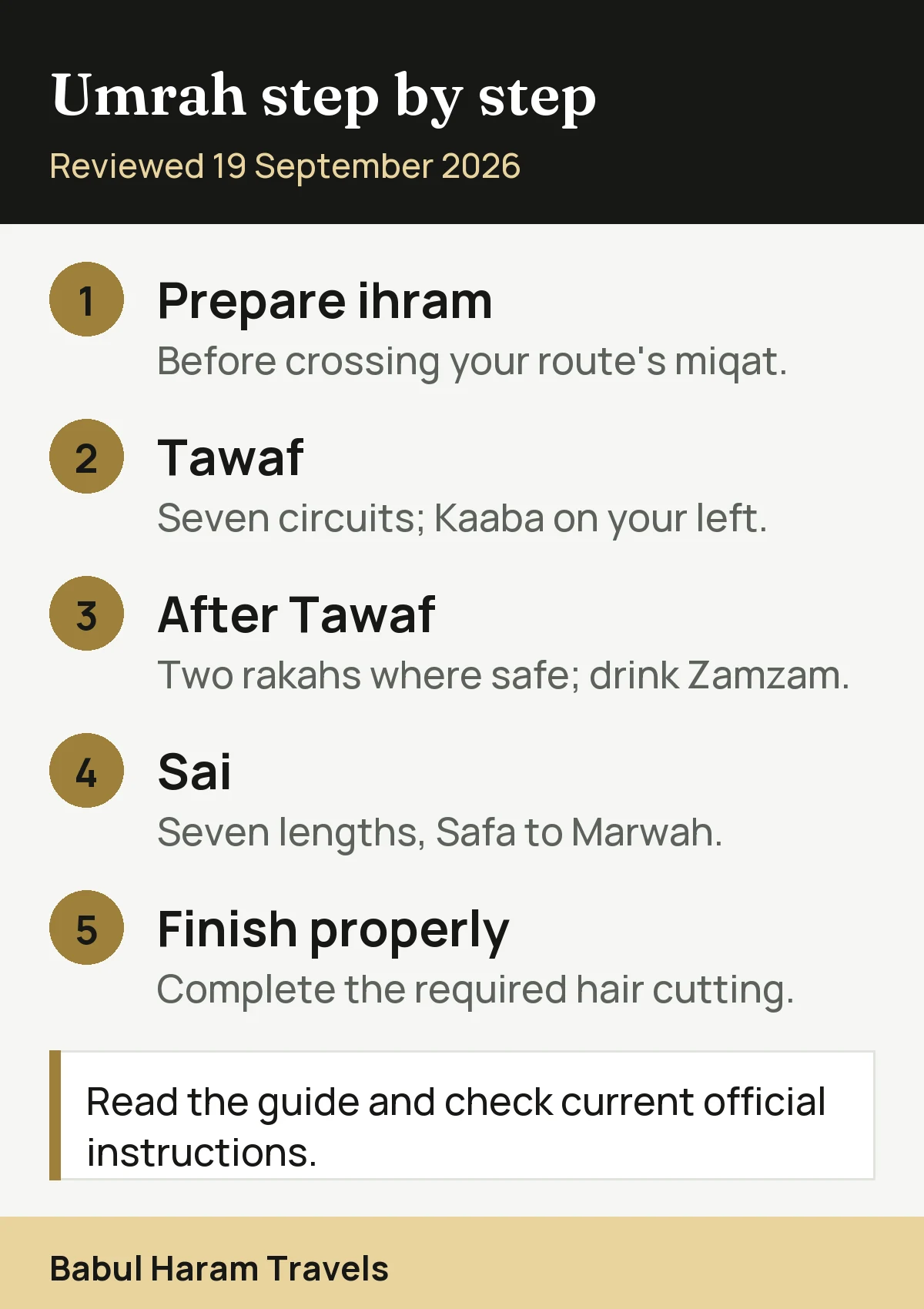
Download the Umrah step-by-step checklist
Babul Haram Travels produced this free checklist for UK pilgrims. It covers every rite in order, what to recite, and the preparation to complete before you fly.
Save it before you travel so it stays available without mobile data, and keep this article bookmarked for the references behind each step.
Tips for performing Umrah from the UK
Seven steps in the order you will need them, whether you fly from London, Manchester or Birmingham.
- Learn the sequence before you fly. Four rites, in order, understood calmly at home.
- Enter ihram before the miqat. Do not wait for an announcement you may not hear.
- Write a dua list. Emotion at the first sight of the Kaaba empties most people’s minds.
- Count on your fingers. Seven circuits of Tawaf, seven lengths of Sa’i.
- Do not force your way to the Black Stone. Pointing from a distance is entirely sufficient.
- Finish Sa’i at Marwah. Not back at Safa.
- Cut hair from all around the head. A few strands from one side is not enough.
Frequently asked questions about performing Umrah
How do you perform Umrah step by step?
Enter ihram at the miqat with the intention, recite the Talbiyah, perform seven circuits of Tawaf, pray two rak’ahs, drink Zamzam, complete seven lengths of Sa’i between Safa and Marwah, then shave or shorten the hair.
How long does Umrah take?
Usually two to four hours depending on crowds. Late night and pre-dawn hours are considerably quicker than the periods around the obligatory prayers. In Ramadan, and particularly in its final ten nights, the same rites can take far longer, so plan for a much slower pace rather than assuming the timings you read elsewhere will hold.
What are the steps of Umrah in order?
Ihram, Tawaf, Sa’i and cutting the hair. Praying two rak’ahs after Tawaf and drinking Zamzam sit between the second and third. The order matters: each rite follows the one before it, and they cannot be rearranged to suit convenience or crowding.
What is Tawaf?
Tawaf is seven circuits around the Kaaba, performed anticlockwise with the Kaaba on your left, each circuit beginning and ending at the Black Stone corner.
Is there a specific dua for each circuit of Tawaf?
No. Assigning a fixed supplication to each circuit is a custom rather than an established Sunnah. Recite Quran, make dhikr and ask for what you need.
How do women perform Umrah differently?
The sequence is identical. Women wear ordinary modest clothing, recite the Talbiyah audibly to themselves, do not perform raml, idtiba or hastening, and end by cutting a fingertip length of hair.
Can you perform Umrah more than once in a trip?
Yes. Each Umrah requires a fresh permit and re-entering ihram from outside the Haram boundary, commonly at Masjid Aisha in Tan’im.
What if I lose count during Tawaf?
Build on the number you are certain of. If you genuinely cannot recall whether you completed four or five, treat it as four and continue.
Can I perform Umrah on behalf of my parents?
Yes, for a parent who has died or who is permanently unable to travel through age or illness. Perform your own Umrah first, then re-enter ihram from outside the Haram boundary and state the intention naming that person.
Do I need to be in wudu for Tawaf?
The majority of scholars require purity for Tawaf. If your wudu breaks, leave, renew it and resume from where you stopped. Sa’i does not carry the same requirement, though performing it in wudu is better.
Can I perform Tawaf on the upper floors?
Yes. Tawaf on the first floor or the roof is entirely valid. The circuits are longer because the circumference is greater, but the space is calmer, which often makes it the better choice for families and older pilgrims.
Perform it with understanding
Umrah is not complicated. Four rites, in order, completed in a few hours. What makes pilgrims anxious is arriving without knowing what comes next and copying whoever is nearest, who is frequently just as unsure.
Almost everything in this guide reduces to three habits. Know the sequence before you arrive, so you are never guessing.
Count deliberately, because seven circuits and seven lengths are the only numbers you must get right. And give way to people, because the crowd around you has travelled just as far as you have and wants exactly the same thing.
Everything else is detail. If you enter ihram with a sincere intention, complete the rites as described here, and treat the people beside you well, you will have performed Umrah properly, whether or not you touched the Black Stone or prayed in the exact spot behind Maqam Ibrahim.
Read this before you fly, take the checklist with you, and give your attention to the worship rather than the mechanics. If you would like the miqat timing, permits, hotel distance and transfers planned around your departure airport, our team will put a written itinerary together before you commit to anything.
Babul Haram Travels is a UK Umrah and Hajj specialist, and we put every quote in writing before you commit.
Editorial review: 19 September 2026. Travel rules and service availability can change; use the linked official sources for your dates. For a personal religious ruling, consult a qualified scholar.
Photo sources: Location photographs are credited under each image and are not representations of our customers, a particular hotel booking or current access routes. Featured photo: Aiman titi, CC BY-SA 3.0. Resized and cropped for this guide.
Photographs retain their linked licences.