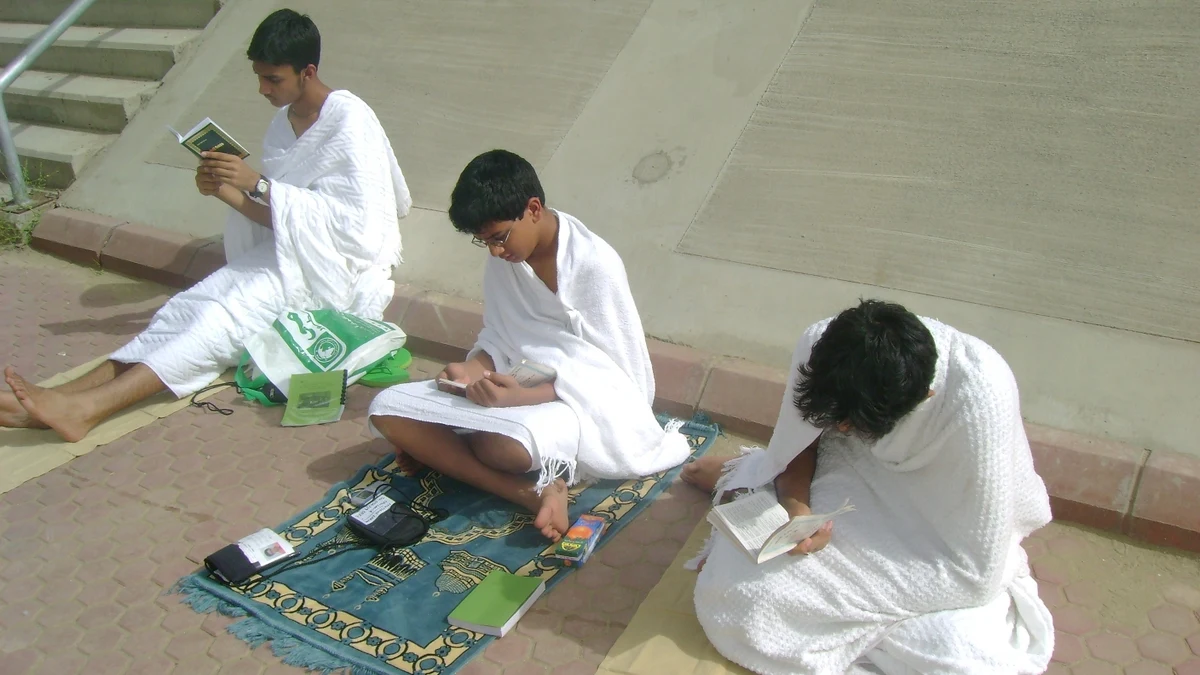
Ihram is the sacred state a pilgrim enters before performing Umrah or Hajj. It is often described as the two white cloths, but the cloths are only the outward part. Ihram is a state of consecration entered with intention, and it carries a set of restrictions that stay with you until the rites are complete.
This guide explains what ihram means, what men and women actually wear, how to tie ihram correctly, where and when it begins for pilgrims flying from the UK, every restriction that applies, what to do if you break one, and the mistakes that cause most avoidable problems.
Where scholars differ, that is stated plainly rather than presented as a single ruling. Where a practice is commonly believed but not established, that is said too.
What is ihram?
Ihram is the condition of ritual consecration that a pilgrim enters in order to perform Umrah or Hajj. Once in this state, certain ordinarily lawful things become temporarily prohibited, and the pilgrim remains in it until the rites that release them are completed.
| Question | Answer |
|---|---|
| What is ihram | A sacred state of consecration entered before Umrah or Hajj |
| How does it begin | With the intention of the heart, at or before the miqat |
| What men wear | Two unstitched cloths, the izar and the rida, head uncovered |
| What women wear | Ordinary modest clothing with the head covered, no fitted veil or gloves |
| When it begins for UK pilgrims | Before crossing the miqat, usually in the air en route to Jeddah |
| When it ends for Umrah | After Tawaf, Sa’i and cutting or shaving the hair |
| Main restrictions | Perfume, cutting hair or nails, hunting, marriage contract, intimacy |
| If a rule is broken | Remedy depends on the act and circumstances; ask a qualified scholar |
What does ihram mean?
The word comes from a root carrying the sense of making something forbidden or sacred. Entering ihram makes a set of normally permitted actions forbidden for the duration of the rites. The person in this state is called a muhrim.
Ihram is a state, not just clothing
This is the single most important point in the whole article. A man wearing the two cloths who has not made the intention is not in ihram. A pilgrim who forms the intention at the miqat is in ihram even before arranging the cloths perfectly.
The distinction that matters. Ihram begins with intention, not with fabric. Pilgrims who assume the clothing is what counts are the ones who cross the miqat unprepared and then need to correct it.
Ihram clothes: what men wear
Men normally wear an izar and a rida, usually plain white. The restriction concerns garments worn fitted to the body or its parts, such as shirts and trousers, rather than the mere presence of stitching. A hem, repair or stitched money belt is not automatically a prohibited garment.
The two cloths explained
The lower cloth is the izar, wrapped around the waist and covering from navel to below the knee. The upper cloth is the rida, draped over the shoulders and upper body. Neither is sewn to fit.
The Prophet ﷺ was asked what a pilgrim in ihram should wear, and the answer listed what may not be worn rather than what must be. That narration is recorded in Sahih al-Bukhari 1542.
What ihram clothes should you buy in the UK?
Buy before you fly. Ihram sets are inexpensive and widely available from Islamic shops across the UK and online. Take a spare set: cloths get wet, stained and torn, and finding a replacement at the right moment in Makkah is harder than packing one.
Choose the weight carefully. Thin ihram cloth becomes transparent when wet and offers little warmth on an air-conditioned aircraft. A slightly heavier towelling weight is more practical for most UK pilgrims, and a second set costs very little.
Footwear
Sandals that leave the ankle bone and the top of the foot exposed are the standard choice. Closed shoes are avoided by men in ihram. Comfort matters more than appearance here: you will walk several kilometres during Tawaf and Sa’i.
Ihram for women
Women enter exactly the same state with the same intention, but the clothing rules are different and much simpler.
What women wear
There is no special garment. A woman wears ordinary modest clothing that covers properly, with her head covered.
Stitched clothing is entirely permitted. White is not required, though many women choose plain, loose and light fabrics for comfort.
The face and hands
The majority position is that a woman in ihram leaves her face and hands uncovered, based on narrations prohibiting the niqab and gloves specifically for the muhrimah, such as Sahih al-Bukhari 1838. Many scholars permit a woman to drape a loose covering over her face when men are passing, provided it is not a fitted niqab.
A point of difference, not a dispute. Scholars hold different views on how a woman may cover her face in ihram. Follow the position of the school you normally follow or ask your local imam rather than trying to settle it from a travel article.
Menstruation and ihram
A woman who is menstruating enters ihram normally, makes the intention and recites the Talbiyah. She does not perform Tawaf until she is pure, but the state of ihram itself is entered without restriction. This is based on the instruction given to Aisha, reported in Sahih al-Bukhari 1650.
How to tie ihram step by step
This is the part most first-time pilgrims are anxious about, and it is genuinely simpler than it looks.
| Step | What you do | Why it matters |
|---|---|---|
| 1. Ghusl and grooming | Trim nails, remove hair, shower | Complete hair and nail grooming before entering ihram |
| 2. Perfume | Apply to the body only, never the cloths | Scent on the cloths is a breach |
| 3. The izar | Wrap the lower cloth firmly at the waist | Secure it without a prohibited fitted garment |
| 4. The rida | Drape the upper cloth over both shoulders | Idtiba applies only during Tawaf |
| 5. Two rak’ahs | Pray where practical | Omitted without penalty if not possible |
| 6. Intention | Form it in the heart, then begin the Talbiyah | This is what actually starts ihram |
Tying the izar
Hold the lower cloth behind you, bring both ends to the front, and wrap it firmly around the waist so it sits above the hip bone. Fold the top edge over itself to lock it in place. It should be secure enough to walk and climb stairs without adjustment.
Draping the rida
Place the upper cloth over both shoulders like a shawl, with roughly equal length hanging at the front and back. Baring the right shoulder, known as idtiba, applies only during Tawaf al-Qudum and is not the normal way to wear the rida at all other times.
Belts, clips and practical fixes
A belt or money belt can secure the izar; stitching in the belt is not the same as wearing a shirt or trousers. The narration in Bukhari 1542 identifies garment types, not a universal ban on every sewn object. Ask your religious guide about pins, clips or adapted garments if you need a school-specific ruling.
Practise at home. Put the cloths on twice before you travel. Pilgrims who first attempt it in an aircraft toilet at 35,000 feet make it far harder than it needs to be.
Before you enter ihram: the Sunnah preparations
These are done before entering the state, because several of them become restricted once you are in it.
Ghusl and grooming
Perform a full wash, trim the nails, remove underarm and pubic hair, and tidy the moustache. All of this must be completed beforehand, since cutting hair and nails is prohibited in ihram.
Perfume before, never after
Perfume may be applied to the body before entering ihram, and its scent remaining afterwards does no harm. Aisha reported perfuming the Prophet ﷺ before he entered ihram, recorded in Sahih al-Bukhari 1539. Perfume must never be applied to the ihram cloths themselves.
Two rak’ahs
Many pilgrims pray two units of prayer before making the intention. Where this is not practical, such as on an aircraft, it is omitted without any penalty.
Check your toiletries. Scented soap, shampoo, deodorant, moisturiser and even some wet wipes are the most common accidental breach. Pack unscented versions in your hand luggage before you fly, not after you land.
Where ihram begins: the miqat
The miqat is the boundary at which a pilgrim must already be in ihram. Crossing it without having made the intention is a violation that requires correction.
The five miqat points
Sahih al-Bukhari 1524 names Dhul Hulayfah, Al-Juhfah, Qarn al-Manazil and Yalamlam for their respective routes. Dhat Irq is also recognised as the miqat on the Iraq route; it is not named in that particular report. Your actual route, not just your departure nationality, determines which boundary you cross.
What UK pilgrims do on a flight
Flying from London, Manchester or Birmingham, you will cross the miqat in the air well before landing. Most airlines announce the approach. Change into ihram before boarding or during the flight, and make the intention before the crossing, not after you land.
| Miqat | Modern name | Who uses it |
|---|---|---|
| Dhul Hulayfah | Abyar Ali | Pilgrims travelling from Madinah |
| Al-Juhfah | Rabigh | Arrivals from the direction of Syria and Egypt |
| Qarn al-Manazil | As-Sayl al-Kabir | Arrivals from Najd and Taif |
| Yalamlam | As-Sa’diyah | Arrivals from the direction of Yemen |
| Dhat Irq | Adh-Dharibah | Arrivals from the direction of Iraq |
| In the air | Announced on board | UK pilgrims flying direct to Jeddah |
Do not rely on the announcement. Announcements are sometimes missed, delayed or made only in Arabic. Know your approximate flight time and enter ihram comfortably ahead of it. Landing at Jeddah and realising you have crossed unprepared is a genuinely common and avoidable problem.

If you are already in Makkah
Residents of Makkah, and pilgrims already inside the boundary who wish to perform a further Umrah, enter ihram from outside the Haram boundary, most commonly at Masjid Aisha in Tan’im.
If you land in Madinah first
Many UK itineraries begin in Madinah and travel to Makkah afterwards. In that case you do not enter ihram on the flight at all. You spend your time in Madinah in ordinary clothing, visit the Prophet’s Mosque and the Rawdah normally, and enter ihram only when you set out for Makkah.
The miqat for that journey is Dhul Hulayfah, known today as Abyar Ali, on the outskirts of Madinah. Coaches stop there so pilgrims can change, pray and make the intention. If you are travelling by Haramain train instead, enter ihram before boarding, because the line does not stop at the miqat.
The train catches people out. The Haramain service is fast and comfortable, but it passes the miqat without stopping. Change into ihram at your Madinah hotel and make the intention before you board, not on arrival in Makkah.
Making the intention and the Talbiyah
The intention is an action of the heart. There is no long formula that must be spoken. Knowing in your heart that you are entering Umrah is sufficient, and many pilgrims say a short declaration such as “Labbayka Umrah”.
The Talbiyah is then recited aloud. Its wording and the full set of supplications for each stage of the journey are set out in our duas for Umrah guide.
What is forbidden in ihram
The restrictions fall into three groups: those that apply to everyone, those specific to men, and those specific to women.
| Forbidden in ihram | Allowed in ihram |
|---|---|
| Perfume or scented products | Washing with unscented soap |
| Cutting hair or clipping nails | Wearing a watch, glasses or a ring |
| Hunting land game | Sheltering under shade or an umbrella |
| Contracting a marriage | Carrying a bag or money belt |
| Intimacy between spouses | Changing into clean replacement cloths |
| Prohibited fitted garments for men | Ordinary stitched clothing for women |
| Covering the head for men | Treating a wound or taking medication |
| Arguing and quarrelling | Killing genuinely harmful creatures |
Restrictions that apply to everyone
Applying perfume or scented products. Cutting hair or clipping nails. Hunting land game or assisting a hunt.
Contracting a marriage or proposing. Intimacy between spouses. Arguing, obscenity and quarrelling, which the Quran addresses directly in Quran 2:197.
Restrictions specific to men
Men avoid prohibited fitted garments such as shirts, trousers and underwear, and do not wear a hat, cap or turban on the head. Ordinary seams in the ihram cloth are not the reason for the restriction. Footwear details and medical exceptions should be checked with your religious guide.
Restrictions specific to women
No fitted face veil and no gloves, per the narration in Sahih al-Bukhari 1838. Ordinary modest stitched clothing is fully permitted and the head remains covered as normal.
| Restriction | Men | Women |
|---|---|---|
| Perfume and scented products | Forbidden | Forbidden |
| Cutting hair or nails | Forbidden | Forbidden |
| Hunting land game | Forbidden | Forbidden |
| Marriage contract or proposal | Forbidden | Forbidden |
| Intimacy | Forbidden | Forbidden |
| Prohibited fitted garments for men | Forbidden | Permitted |
| Covering the head | Forbidden | Required as normal |
| Fitted face veil and gloves | Not applicable | Avoided |
| Washing with unscented soap | Permitted | Permitted |
| Umbrella, shade and bags | Permitted | Permitted |
Everyday Ihram Questions: What Is Allowed?
Pilgrims often restrict themselves far more than the rules require, so it is worth stating the permissions clearly.
| Question | Short answer | Important distinction |
|---|---|---|
| Can I use the toilet? | Yes; this does not end ihram | Clean yourself normally and renew wudu when required for prayer. Ihram and wudu are different states |
| Can I shower or change the cloths? | Yes | Use unscented products and avoid deliberate hair removal; clean replacement cloths do not require a new intention |
| Can I brush my teeth? | Oral hygiene is allowed | A miswak or unscented option avoids fragrance concerns; ask your guide about a particular product rather than neglecting hygiene |
| Can women wear a bra and underwear? | Yes, beneath appropriate modest clothing | The men’s restriction on fitted garments does not apply to women’s ordinary clothing |
| Can men wear ordinary underwear under the izar? | Not as ordinary ihram clothing | For a medical need, arrange advice about the garment and any religious consequences before travelling |
| Can I use a stitched money belt? | Yes | A seam is not itself the prohibition; a belt is different from a shirt or trousers worn fitted to the body |
Washing the head while in ihram is described in Sahih al-Bukhari 1840. The garment restrictions are set out in Bukhari 1542; neither should be turned into a rule that ordinary cleanliness breaks ihram.
You may wear a watch, spectacles, a ring or a hearing aid, carry a bag, and shelter under an umbrella or in shade. Changing clothing or losing wudu does not, by itself, finish your Umrah.
You may take prescribed medication and have a wound dressed. You may kill genuinely harmful creatures.
Shade is not a violation. Sitting under an umbrella, a canopy or in an air-conditioned coach does not breach ihram for men. What is prohibited is covering the head directly with something worn on it.
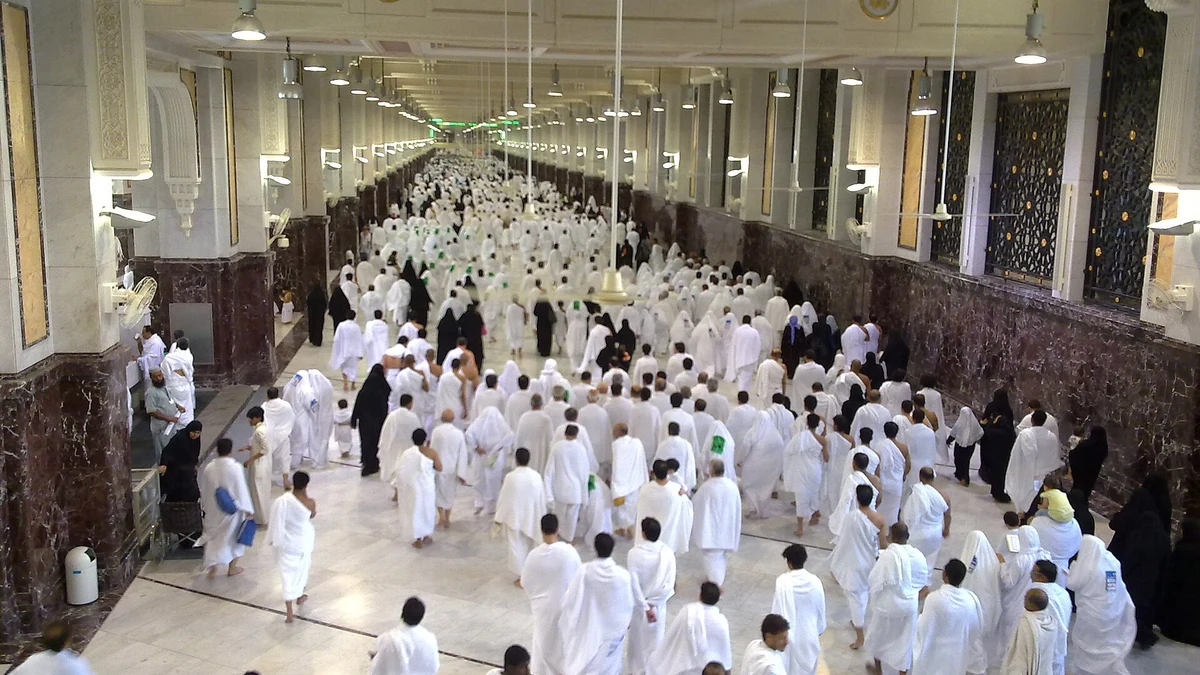
What happens if you break a rule?
Mistakes happen, and the ruling depends heavily on whether the act was deliberate and which restriction was involved.
Done by genuine forgetfulness or ignorance
Stop the action when you notice it, but do not assume one rule covers every mistake. The act, its extent, necessity, intention and your school of law can affect whether compensation is due. Record those details and ask a qualified scholar; clothing or fragrance cases should not be treated as identical to hair removal or intimacy.
When fidyah may be required
Quran 2:196 discusses compensation when illness or a scalp ailment requires shaving. The case of Ka’b ibn Ujrah in Sahih al-Bukhari 1814 gives the alternatives of fasting three days, feeding six poor people or sacrificing a sheep. Do not extend that case into a single self-prescribed remedy for every restriction.
Acts that invalidate
Intimacy before leaving ihram is treated far more seriously than the other restrictions and carries its own consequences. Any pilgrim in this situation should ask a qualified scholar directly rather than relying on general guidance.
Do not guess. If you think you have breached a restriction, ask a qualified scholar or your group’s religious guide while you are still there. Almost every case is resolved easily, and worrying about it silently for the rest of the trip helps nobody.
Ihram for Umrah compared with Hajj
The state and its restrictions are identical. What differs is how long you remain in it and what releases you from it.
For Umrah, ihram ends after Tawaf, Sa’i and cutting the hair, usually within hours. For Hajj it can last several days across Mina, Arafat and Muzdalifah, with a partial release after the first stoning and shaving. Our comparison of the two journeys is in difference between Hajj and Umrah.
There are also three ways of combining the two. Tamattu’ means performing Umrah, leaving ihram, then re-entering it for Hajj. Qiran means holding one ihram for both.
Ifrad means Hajj alone. Most pilgrims from the UK perform Tamattu’, which is why they enter ihram twice on a Hajj trip.
The full sequence of rites that follows entering ihram is set out step by step in how to perform Umrah.
When does ihram end?
For Umrah, ihram ends with the cutting of hair after Sa’i is complete. Until that moment every restriction still applies, including for pilgrims who have already finished Tawaf.
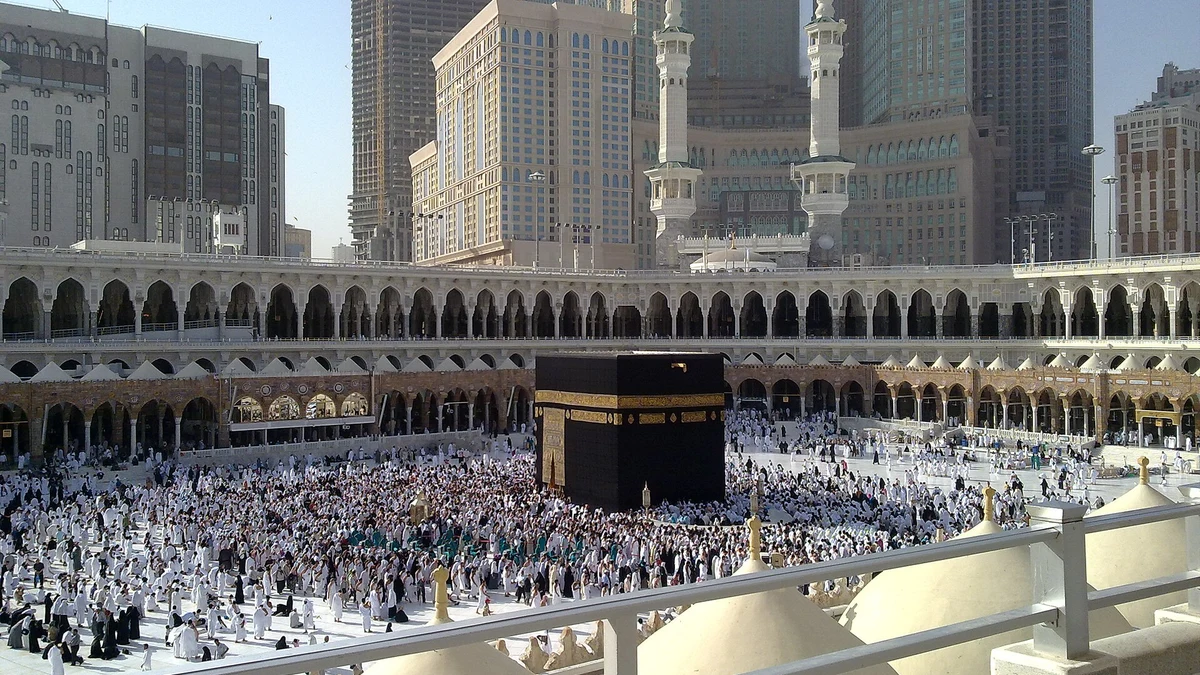
Halq and taqsir for men
Men either shave the head completely, known as halq, or shorten the hair all over, known as taqsir. The Prophet ﷺ supplicated for those who shaved, as reported in Sahih al-Bukhari 1727. Minimum shortening requirements differ by school, so follow a qualified guide rather than copying a token trim.
For women
A woman gathers her hair and cuts approximately a fingertip length from the end. Women do not shave the head.
The most common last-minute error. Cutting only a few strands from one side is not sufficient for taqsir. Take from all around the head, or have it done at one of the barbers near the Haram who do this all day.
Ihram for children
Children who have not reached puberty are not obliged to perform Umrah, but many UK families bring them and enter them into ihram. The rites are valid and rewarded, and the child is helped through them by the parent.
What children wear
Boys wear the two cloths in the same way as adult men, in a smaller size. Girls wear ordinary modest clothing exactly as adult women do. Child-size ihram sets are sold in the UK and are much easier to source here than in Makkah.
How strict are the restrictions?
A child who breaches a restriction through play or forgetfulness is not held to account in the way an adult is. The parent makes the intention on behalf of a child too young to form it, and guides them through the rites at a realistic pace.
Be realistic about pace. Seven circuits of Tawaf and seven lengths of Sa’i is a long distance for small legs. Plan rest, water and a quieter time of day rather than attempting it in the busiest hours.
Ihram if you have a medical condition
Ihram accommodates genuine need, and pilgrims routinely restrict themselves further than the rules require out of caution.
Medication, dressings and devices
Prescribed medication may be taken normally. Wounds may be dressed, and medical devices such as hearing aids, glasses, insulin pumps and support items are permitted. Unscented creams and ointments prescribed for a condition are not treated as perfume.
When a restriction cannot be kept
The Quran addresses exactly this in Quran 2:196, permitting a pilgrim who must shave because of illness or a scalp ailment to do so and offer compensation. The principle is that genuine necessity is provided for, not that the pilgrim should suffer.
Check vaccination and health requirements well before departure on TravelHealthPro, and speak to your GP if you manage a long-term condition.
Tell your operator in advance. Wheelchair assistance, ground-floor rooms and hotels closer to the Haram all need arranging before departure. If mobility is a concern, raise it when you ask for a written quote rather than on arrival.
Common mistakes UK pilgrims make
These come up on almost every departure from British airports.
Using scented soap or deodorant after entering ihram. Crossing the miqat without making the intention. Covering the head while sleeping on the aircraft.
Wearing stitched underwear beneath the izar. Packing only one ihram set.
Cutting too little hair at the end. Applying perfume to the cloths rather than the body before entering the state.
Two more are worth naming. The first is treating the cloths as the whole of ihram and forgetting the intention entirely, which is the error this article opened with. The second is the opposite problem: pilgrims who become so anxious about the restrictions that they spend the journey worrying rather than worshipping.
The restrictions are finite, well documented and mostly easy to keep. Read them once properly, prepare for them at home, and then give your attention to why you travelled.
Prepare the small things at home. Unscented toiletries, a spare ihram set, a money belt and comfortable sandals solve most of the list above, and all of them are easier to sort in the UK than in Makkah.
Practical tips for wearing ihram comfortably
Ihram is worn for hours at a time in heat and crowds, so comfort is a legitimate concern rather than a distraction.
Secure the izar higher than feels natural, because it settles as you walk. Use a money belt for passport and phone so your hands stay free during Tawaf. Keep a spare set in your day bag.
Wear sandals you have already broken in. Bring unscented wet wipes for the heat.
Managing the heat
White cloth reflects heat well, which is part of why it is the traditional choice. Stay in shade between rites, drink Zamzam regularly at the dispensers, and avoid the open marble at midday when the surface temperature is at its highest. Our guide to Zamzam water covers the Sunnah of drinking it.
Sleeping in ihram
Men must not cover the head, which catches many pilgrims out while dozing on the aircraft or coach. A blanket over the body is fine; pulling it over the head is not. Set your hood down and keep the blanket at shoulder level.
What to pack for ihram from the UK
Almost every avoidable problem with ihram is solved by what goes into the suitcase in Britain.
Pack two ihram sets for men and light modest clothing for women. Bring a suitable money belt and comfortable, already worn-in sandals. Check the footwear detail you follow before departure.
Unscented soap, shampoo, deodorant and wet wipes. A small bag for footwear inside the Haram.
A refillable bottle. Prescription medication in its original packaging with a copy of the prescription.
Ihram goes in hand luggage. Check the liquid rules for every departure and transfer airport; limits and exceptions vary. Travel-size unscented toiletries are convenient, but your cloths should remain with you if a checked bag is delayed.
The meaning behind the two cloths
It is worth pausing on why ihram looks the way it does, because understanding it changes how the journey feels.
Every marker of status disappears. The consultant and the taxi driver, the Londoner and the pilgrim from Lagos, all stand in two pieces of unsewn cloth that cost a few pounds.
Nothing indicates income, profession or background. The Quran describes people being called to the pilgrimage from every distant path in Quran 22:27, and the uniform is part of how that call is answered.
The restrictions work in the same direction. Grooming, perfume, argument and intimacy are all set aside, not because any of them is wrong, but because for a short period the pilgrim is occupied with something else entirely.
What the cloth is for. The restrictions are not obstacles placed in the way of the journey. They are the journey, narrowing attention until very little is left except why you came.
Ihram and UK airports
Changing at the airport is normal and most large UK departure terminals serving Jeddah and Madinah have space to do so. Many pilgrims change after security to avoid complications at the scanners.
Carry your ihram in hand luggage, not in the hold, so a delayed bag cannot leave you without it. Check current entry requirements on GOV.UK and confirm permit arrangements on Nusuk before you travel. Our guide to the Umrah visa from the UK covers the paperwork side.
Download the ihram checklist
Babul Haram Travels produced this free checklist for UK pilgrims. It covers what to pack, the Sunnah preparations, every restriction and the steps that end ihram.
Save it before you fly so it stays available without mobile data, and keep this article bookmarked for the references behind each ruling.
Tips for entering ihram from the UK
Seven steps in the order you will need them.
- Buy two ihram sets before you fly. Spares cost very little and replacing one mid-journey is inconvenient.
- Swap to unscented toiletries. Do this while packing, not at the hotel.
- Practise wrapping the cloths at home. Twice is enough to remove the anxiety entirely.
- Complete grooming before departure. Nails and hair cannot be cut once you are in ihram.
- Know your miqat timing. Enter ihram before the crossing rather than relying on the announcement.
- Keep ihram in hand luggage. A delayed suitcase should never affect your rites.
- Cut hair properly at the end. From all around the head, not a few strands.
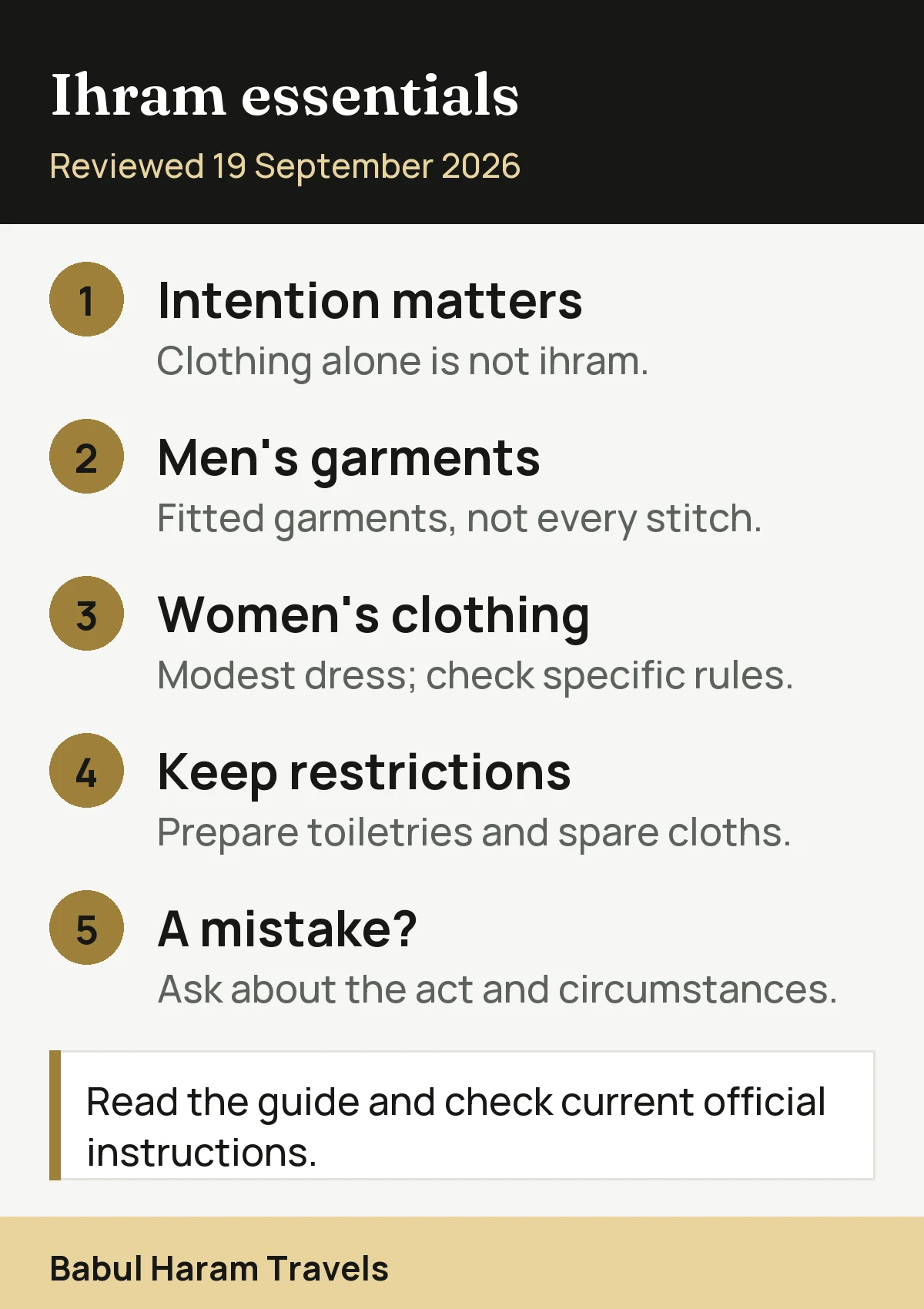
Frequently asked questions about ihram
What is ihram?
Ihram is the sacred state a pilgrim enters before Umrah or Hajj, begun with the intention at or before the miqat. It carries restrictions that remain until the rites releasing them are completed.
How do you tie ihram?
Wrap the izar firmly around the waist and fold its top edge to secure it, then drape the rida over both shoulders. A suitable belt can help; stitching in a belt is not itself the fitted-garment restriction.
What do women wear for ihram?
Ordinary modest clothing with the head covered. There is no special garment, stitched clothing is permitted, and white is not required. A fitted face veil and gloves are avoided.
Can you wear underwear under ihram?
Men do not wear ordinary fitted underwear while in ihram. A money belt is a different item and can secure the izar; ask about any garment needed for a medical condition. Women wear their normal modest clothing and underwear.
What is forbidden in ihram?
Restrictions include applying perfume, deliberate hair or nail removal, hunting, marriage arrangements and intimacy. Men also avoid prohibited fitted garments and direct head coverings; women do not wear a fitted niqab or gloves. Ask a qualified scholar about exceptions and any remedy rather than treating all breaches alike.
Can you shower in ihram?
Yes. Washing and showering are permitted using unscented soap. Take care not to deliberately remove hair while washing.
What if I break an ihram rule by accident?
Stop when you notice the mistake and record what happened. Whether compensation is due depends on the particular act, circumstances and school of law. A qualified scholar should assess it; this guide does not give a blanket exemption or penalty.
When does ihram end for Umrah?
After Tawaf and Sa’i are complete and the hair has been shaved or shortened. Every restriction applies until that point.
Where do UK pilgrims enter ihram?
Flying direct to Jeddah, you enter ihram before crossing the miqat in the air, changing either at the airport or on board. If your itinerary begins in Madinah, you enter ihram at Dhul Hulayfah, known today as Abyar Ali, when you set out for Makkah.
Can you wear a belt or carry a bag in ihram?
Yes, a suitable belt, bag or waist pouch can be used. The fitted-garment restriction is not a ban on stitching in every accessory. Ask your religious guide if an item also functions as fitted clothing or is needed for a medical condition.
Is ihram the same for Hajj and Umrah?
The state and its restrictions are identical. The difference is duration: Umrah ihram usually lasts hours, while Hajj ihram can last several days and, for Tamattu’, is entered twice.
Enter the state, not just the cloth
Ihram strips away the markers that separate people. Wealth, profession and background disappear into two pieces of plain cloth, and everyone stands in the same condition asking the same Lord.
Prepare the practical side in the UK so that none of it distracts you once you arrive. If you would like the miqat timing, transfers and hotel distance planned around your departure airport, our team can put a written itinerary together before you commit.
Buy the cloths early, practise wrapping them, swap your toiletries for unscented versions and know roughly when your aircraft will cross the boundary. Those four things remove almost every difficulty pilgrims report, and they all happen before you leave home. You can compare durations and hotel distances on our Umrah packages page, or see what the whole journey typically costs in our published Umrah package options.
Babul Haram Travels is a UK Umrah and Hajj specialist, and we put every quote in writing before you commit.
Editorial review: 19 September 2026. Travel rules and service availability can change; use the linked official sources for your dates. For a personal religious ruling, consult a qualified scholar.
Photo sources: Location photographs are credited under each image and are not representations of our customers, a particular hotel booking or current access routes. Featured photo: Karim Manji, CC BY-SA 4.0. Resized and cropped for this guide.
Photographs retain their linked licences.