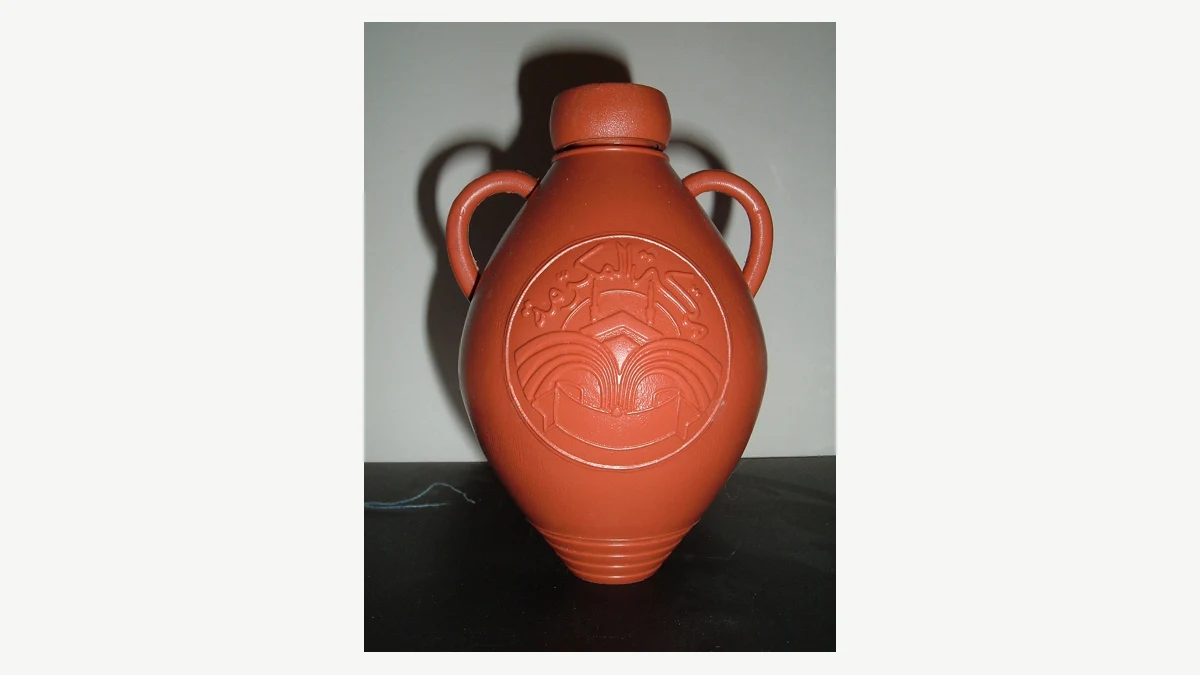
Zamzam water is the water of the well that sits a few metres from the Kaaba inside Masjid al-Haram in Makkah. Muslims have drunk from it for thousands of years, pilgrims carry it home from every Umrah and Hajj, and it holds a status in Islam that no other water shares.
This guide explains what Zamzam water is, where the well came from, what the Quran and Sunnah actually establish about it, how it is treated and bottled today, the Sunnah manner of drinking it, and the practical rules for bringing zam zam water back to the UK without it being refused at the airport.
It also separates what is authentically reported from what circulates online. A great deal written about Zamzam mixes sound narrations with unverified health claims, and pilgrims deserve the difference to be made clear.
What is Zamzam water?
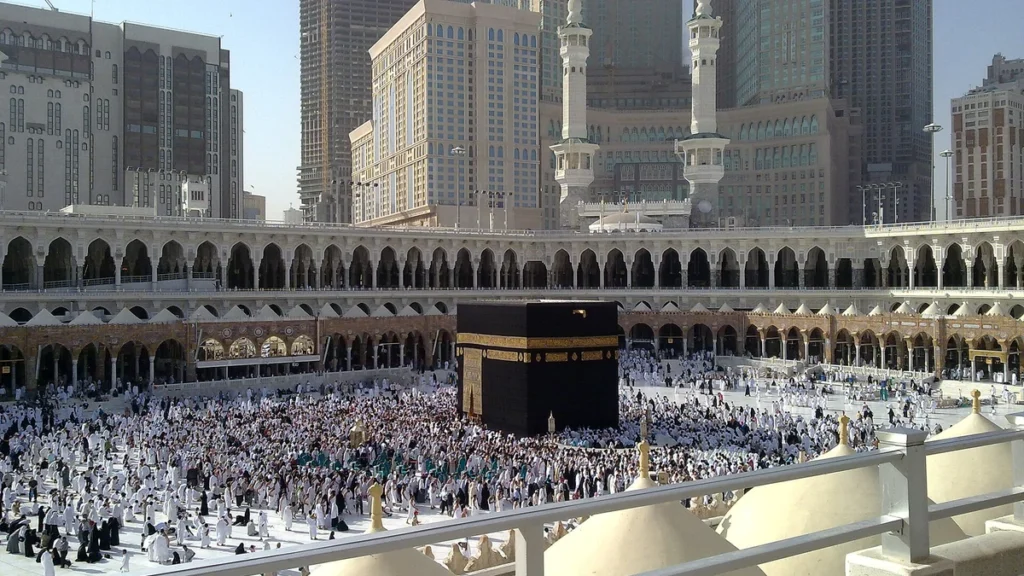
Zamzam water is groundwater from a well located inside Masjid al-Haram, roughly twenty metres east of the Kaaba. It is not a spring in the ordinary sense and it is not bottled mineral water from a commercial source. It comes from one specific well, in one specific place, with a history that runs back to the family of Prophet Ibrahim.
| Question | Answer |
|---|---|
| What is it | Groundwater from a single well inside Masjid al-Haram in Makkah |
| Where is the well | In the Mataf area, roughly twenty metres east of the Kaaba |
| Meaning of the name | Linked to the sense of gathering or containing water |
| Status in Islam | Blessed water, drunk by the Prophet ︎, tied in the Sunnah to the drinker’s intention |
| Can you visit the well | No, the wellhead was covered during expansion; water is supplied by dispenser |
| Available in Madinah | Yes, Masjid an-Nabawi is supplied from the same source |
| Taking it home | Permitted in hold baggage in a sealed official container |
| In hand luggage | Large containers require airline approval; airport liquid rules vary |
What does Zamzam mean?
The name is generally explained as coming from the sense of gathering or holding something together. The traditional account is that when the water gushed forth, Hajar tried to contain it with sand, saying words understood to mean “stop, stop” or “gather, gather”, and the well took its name from that moment.
Spelling note. You will see it written as Zamzam, Zam Zam and occasionally zam water. They all refer to the same well in Makkah. The one-word form is the most common in English scholarly writing.
Where is the well of Zamzam water?
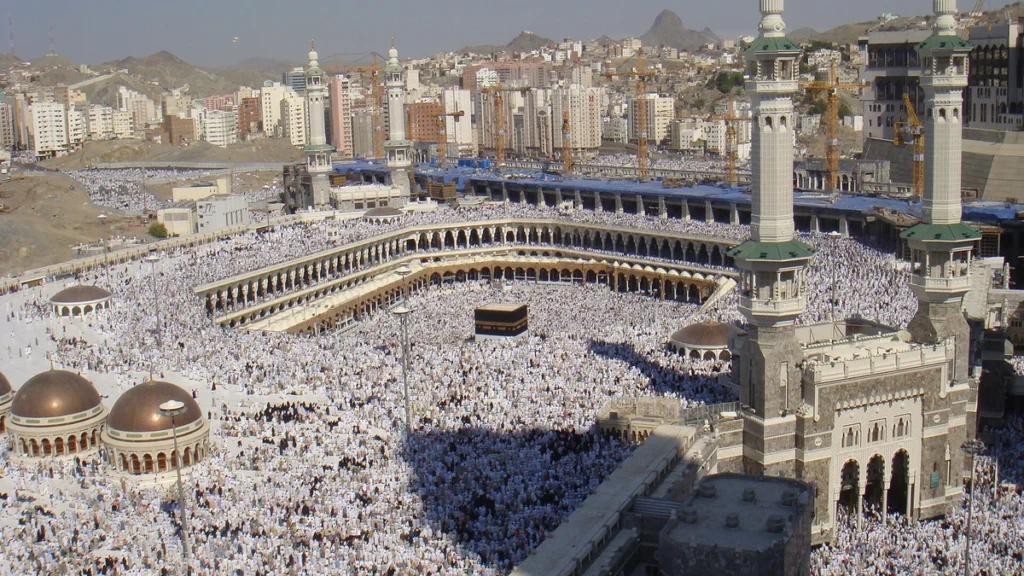
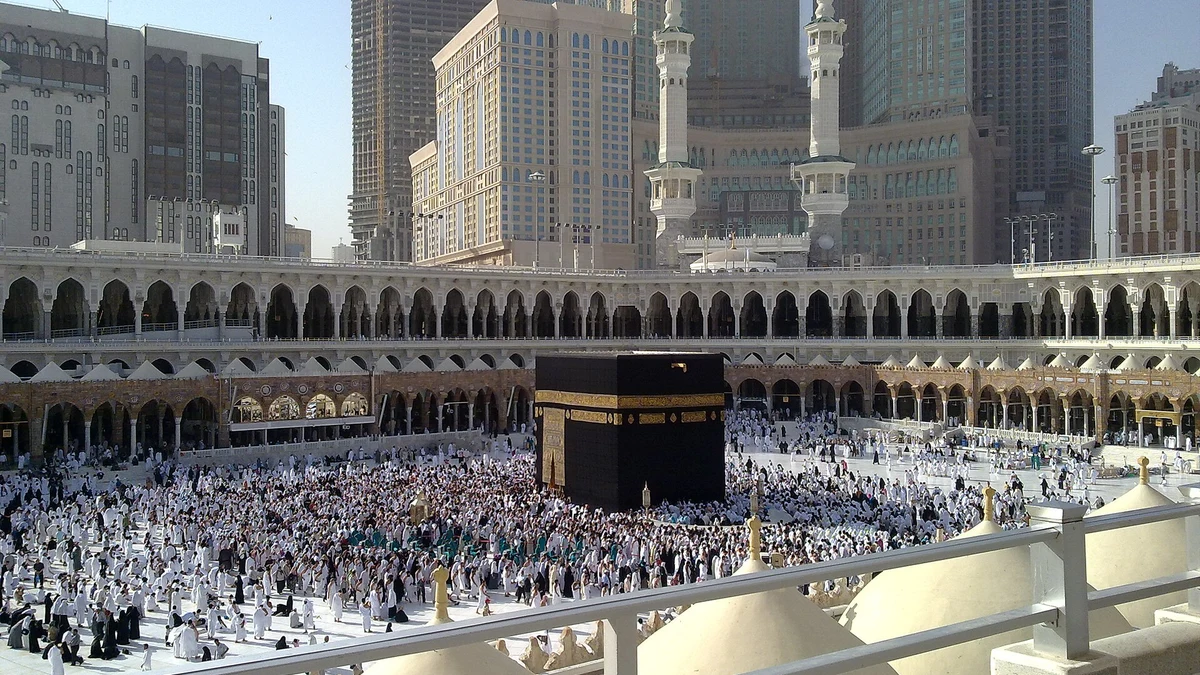
The well lies within the Mataf area of Masjid al-Haram. Pilgrims performing Tawaf pass close to it on every circuit, though the wellhead itself is no longer open to the public. Access was covered over during expansions of the mosque so that the Tawaf area could be widened, and the water is now delivered to pilgrims through taps, coolers and sealed containers instead.
That is why pilgrims looking for the well during Umrah do not find an open shaft. What they find are ranks of dispensers throughout the Haram and in Masjid an-Nabawi in Madinah, all fed from the same source.
The origin of the well of Zamzam
The story of the well is one of the most widely known accounts in Islamic tradition, and it explains why Sa’i between Safa and Marwah is part of both Umrah and Hajj.
The story of Hajar and Isma’il
Prophet Ibrahim left his wife Hajar and their infant son Isma’il in the barren valley of Makkah at Allah’s command. When their water ran out, Hajar ran between the hills of Safa and Marwah seven times searching for help.
Water then appeared at the feet of the infant. The full narration is recorded in Sahih al-Bukhari 3364.
The Prophet ﷺ is reported in that same narration to have said that this is why people perform Sa’i between the two hills. The Quran also refers to Safa and Marwah as among the symbols of Allah in Quran 2:158.
Why this matters when you perform Umrah. Sa’i is not a symbolic walk added to the rites. It retraces the search of a mother for water for her child, and the well you drink from afterwards is the answer to that search.
The rediscovery of the well
Over generations the well was lost beneath the sand and its location forgotten. Traditional accounts describe it being rediscovered by Abd al-Muttalib, the grandfather of the Prophet ﷺ, who re-excavated it and restored it to use before the coming of Islam.
Prophet Ibrahim’s prayer for the valley and its people is preserved in Quran 14:37, where he asks that hearts be inclined towards them and that they be provided with fruits. The well is part of how that provision took shape.
The valley before the well. The Quran describes Ibrahim being shown the site of the House in Quran 22:26. Makkah grew around a water source in a place that had none, which is why the well and the city cannot really be separated.
What the Sunnah establishes about Zamzam
This is where precision matters. Several narrations about Zamzam are authentic and well known; many claims attached to it are not.
“Zamzam is for whatever it is drunk for”
The best-known narration reports the Prophet ﷺ saying that the water of Zamzam is for whatever it is drunk for, recorded in Sunan Ibn Majah 3062. Scholars have understood this as an encouragement to drink it with a clear, sincere intention, whether for guidance, healing, knowledge or any lawful need.
How to apply it. Form your intention before you drink, not after. Many pilgrims decide in advance what they are asking for, then drink while making that dua. The narration ties the benefit to the intention.
“It is food that satisfies”
In the account of Abu Dharr, who lived near the Kaaba for a period with no provision other than Zamzam, the Prophet ﷺ described it as blessed and as food that satisfies. This is reported in Sahih Muslim 2473.
The Prophet ﷺ drank it himself
The Prophet ﷺ drank Zamzam during his pilgrimage, as recorded in Sahih al-Bukhari 1637. That report supports drinking it, not a modern airline allowance or a particular packing method. Check those practical arrangements separately.
A report also describes drinking Zamzam while standing in Sahih al-Bukhari 1638. Scholars discuss drinking etiquette in different ways; this article does not present sitting or standing as a condition for its blessing. Follow reliable scholarly guidance without obstructing others at the dispensers.
The benefits of Zamzam water
The established benefits of Zamzam are religious and connected to intention. Beyond that, honesty requires care.
The spiritual standing
Zamzam is blessed water connected to a place of worship, drunk by the Prophet ﷺ, and linked in the Sunnah to the intention of the one drinking. That standing is agreed upon and needs no supporting claims from anywhere else.
What should not be claimed
A great deal of online content attributes specific medical properties to Zamzam, often citing studies that are either misquoted or cannot be traced. Presenting Zamzam as a treatment for named illnesses goes beyond what the sources establish and is not something a travel guide should do.
Our position. Drink Zamzam for its established blessing and with a sincere intention. Do not stop prescribed medical treatment, and do not rely on claims you cannot verify. Speak to your GP about any health concern.
How Zamzam reaches you today
Modern pilgrims rarely see the well. What they see is the end of a managed supply chain that runs from the wellhead to a dispenser or sealed container. Airline-approved containers may need to travel separately from a suitcase.
| Stage | What happens | Why it matters to you |
|---|---|---|
| 1. Drawn at the well | Water is drawn from the well inside Masjid al-Haram and pumped onward | Every genuine container traces back to this one source |
| 2. Treated and filtered | Use the official supply and current product handling guidance | Do not infer an individual medical guarantee |
| 3. Sealed and bottled | Filled into approved containers and sealed | The seal is what makes it acceptable for air travel |
| 4. Distributed | Sent to authorised outlets in Makkah and Madinah | Buy here, not from street sellers |
| 5. Carried home | Checked into hold baggage and declared at check-in | Confirm your airline’s allowance before you buy |
The well and the pumping station
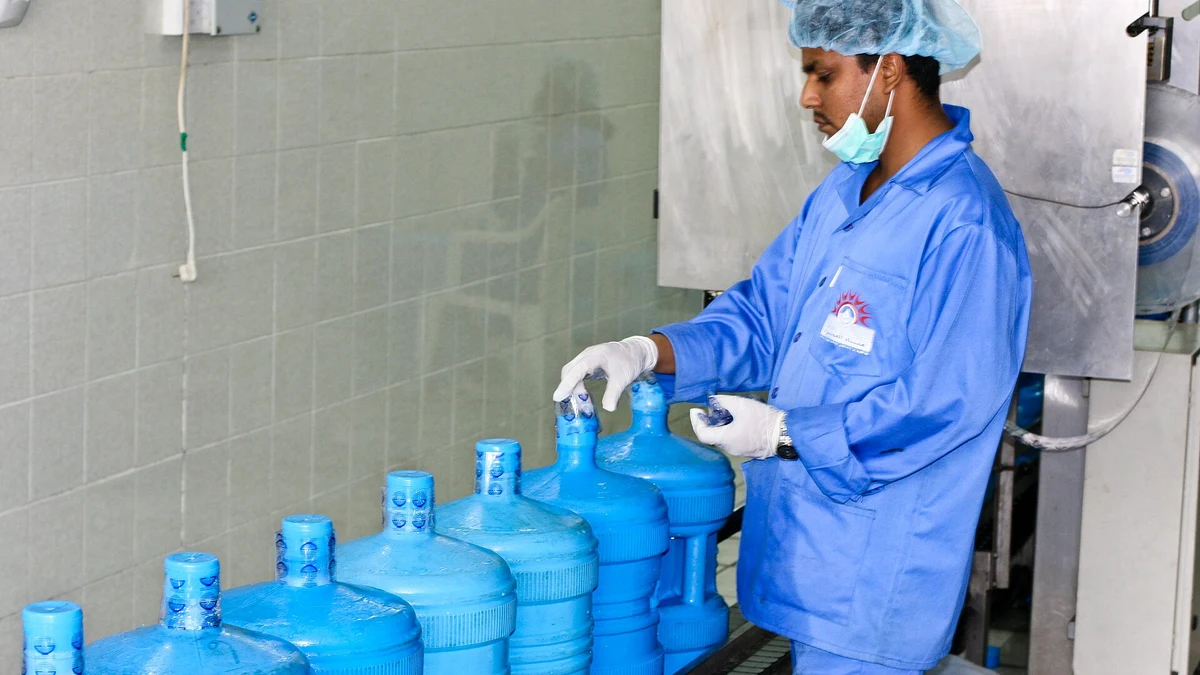
Water is drawn from the well and pumped to a dedicated treatment and bottling facility outside the Haram. The King Abdullah bin Abdulaziz Zamzam Water Project was established to manage this process at the scale that millions of annual pilgrims require.
Treatment, testing and bottling
Use the official supply inside the mosques or a sealed product from an authorised seller, and follow the handling instructions on that container. Specific treatment and testing claims require current technical evidence, rather than a travel company’s assurance. Do not assume an unlabelled street purchase has the same provenance.
Pilgrim services, permits and official guidance for visitors are published through the Saudi Nusuk platform, which is the reference point to check if arrangements change between seasons.
Buy from authorised outlets only. Sealed containers from official distribution points are the ones accepted for air travel. Water sold loose on the street, or decanted into a bottle by a vendor, will usually be refused at check-in.
Is Zamzam water safe to drink?
The water supplied inside the Haram and through official sealed containers is treated and quality-tested by the Saudi authorities. Millions of pilgrims drink it every year from the dispensers throughout both mosques.
Do not dismiss every water-quality concern as counterfeit product without checking the evidence. Buy through recognised channels, inspect the seal and follow official handling guidance. Anyone with a medical restriction should seek individual advice rather than relying on broad claims in a travel guide.
The water is naturally high in certain dissolved minerals, which is characteristic of groundwater in that region and gives Zamzam its distinctive taste. Pilgrims sometimes expect it to taste like bottled mineral water from home and are surprised that it does not.
If you are on a restricted diet. Anyone managing a medical condition that requires monitoring of mineral or sodium intake should raise it with their GP before travelling, as they would with any change in drinking water.
How to drink Zamzam the Sunnah way
There is no lengthy ritual attached to drinking Zamzam, but several practices are reported and widely followed.
Face the qiblah and say Bismillah
Begin with the name of Allah as with any drink. Many pilgrims face the qiblah while drinking Zamzam, a practice reported from the Companions.
Drink in three breaths
The general Sunnah of drinking in three breaths rather than one long draught applies here as it does to any drink, and is reported in Sahih Muslim 2028.
Drink to your fill and make dua
Unlike ordinary drinking, pilgrims are encouraged to drink Zamzam to satisfaction rather than sparingly. Make your dua while drinking, in whatever language you understand, and finish with praise of Allah.
A practical tip inside the Haram. The dispensers are busy during peak Tawaf hours. If you want unhurried time to make dua, use the coolers on the upper levels or on the outer courtyards rather than those beside the Mataf.
Making dua when drinking Zamzam
There is no single fixed wording that must be recited. The narration about intention means your own dua, in your own words, is entirely appropriate.
Many pilgrims prepare a short list beforehand: parents, family, health, guidance, forgiveness, and a specific need. If you would like a structured set of supplications for the whole journey, our duas for Umrah guide arranges them in order.
Ask in a language you understand. Personal dua does not need to be in Arabic. The general encouragement to call upon Allah is stated in Quran 40:60. Sincerity and attention matter more than reciting words whose meaning you do not know.
Where to get Zamzam in Makkah and Madinah
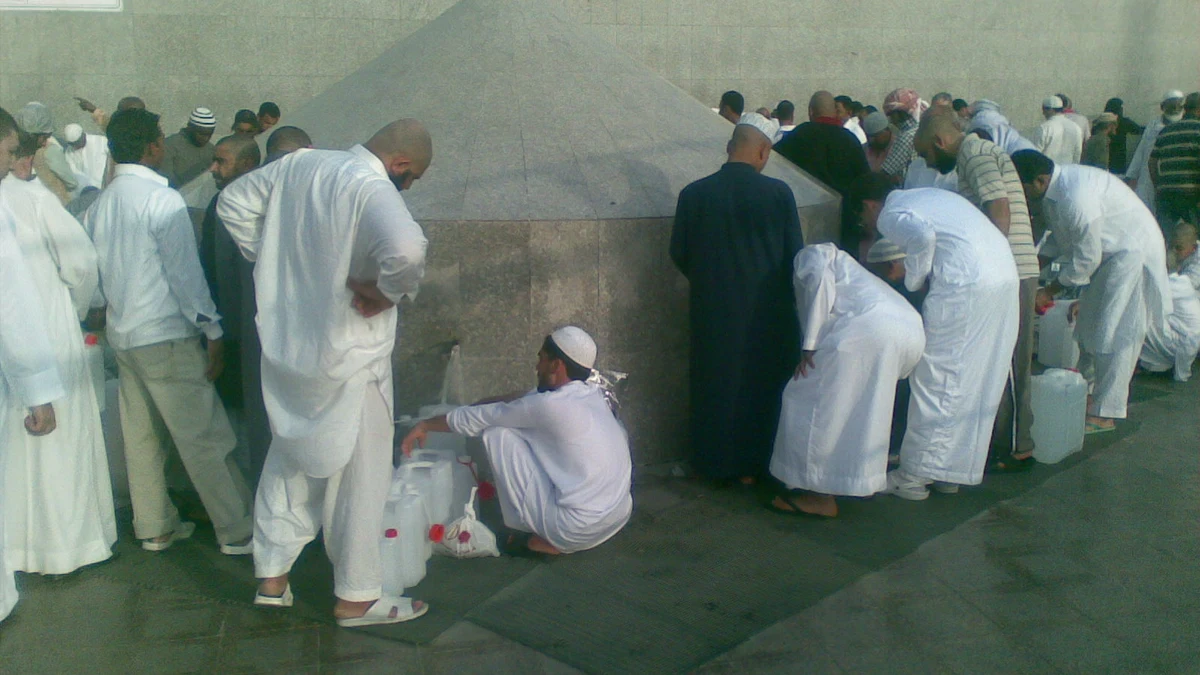
Inside Masjid al-Haram, dispensers and coolers are positioned throughout the Mataf, the upper floors and the courtyards. Masjid an-Nabawi in Madinah is supplied from the same source, so pilgrims can drink Zamzam there as well.
In Madinah the dispensers sit along the main prayer halls and around the courtyards, including near the area pilgrims pass when visiting the Rawdah. If your permit slot is early, drink before you queue rather than during, since the movement through that area is managed and continuous.
Sealed containers for taking home are sold through authorised outlets and at the dedicated distribution points near the airports. Many UK operators, including us, arrange collection as part of the departure transfer so pilgrims are not carrying containers around the city.
If you are travelling between the two cities. Do not buy your sealed container before moving between Makkah and Madinah. Carrying five litres onto the Haramain train or a coach transfer is avoidable weight, and Zamzam is available in both cities.
When pilgrims drink Zamzam during Umrah
Zamzam appears at a specific point in the sequence of rites, which is worth knowing before you arrive.
After Tawaf and the two rak’ahs
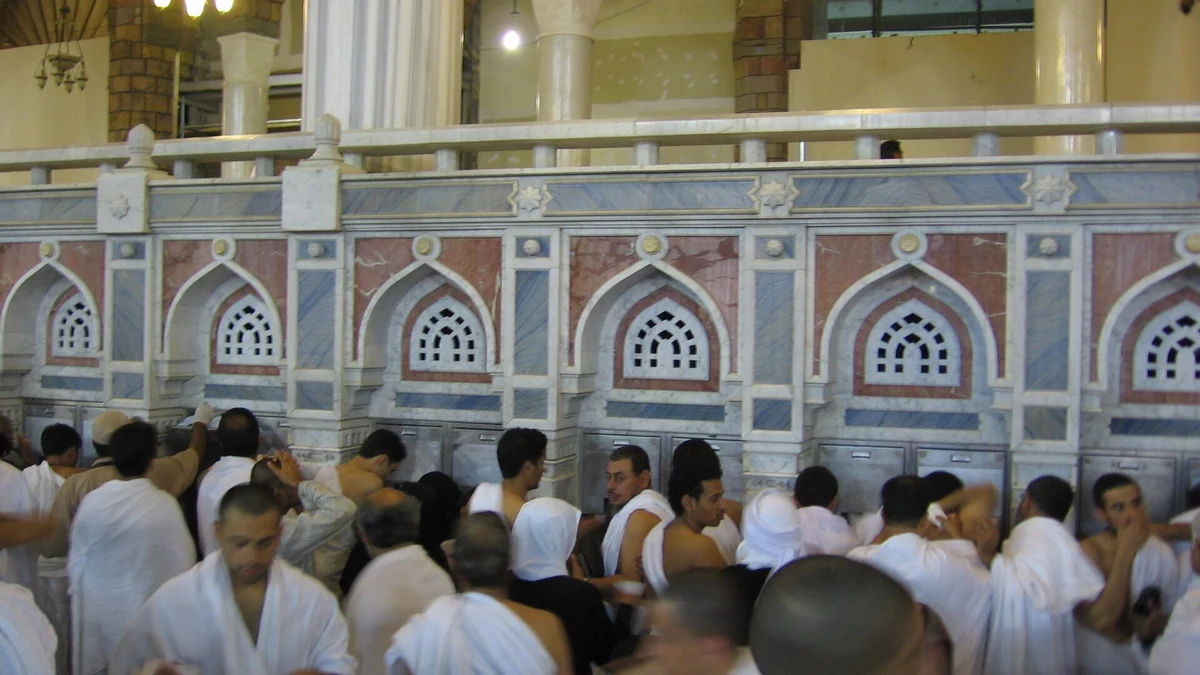
The established order is to complete seven circuits of Tawaf, pray two rak’ahs behind Maqam Ibrahim where practical, and then drink Zamzam before proceeding to Sa’i. The House and the standing place of Ibrahim are both referred to in Quran 2:125.
Our full walkthrough of the sequence is in how to perform Umrah, and the clothing and restriction rules that apply while you are in ihram are covered in ihram rules.
At any other time you wish
Outside the rites there is no restriction at all. Pilgrims drink Zamzam before and after every prayer, throughout the day, and during their stay in Madinah. There is no limit and no special permission required.
Stay hydrated deliberately. Tawaf and Sa’i together cover several kilometres, often in heat. Drinking Zamzam at the dispensers between rites is both a Sunnah and sensible practice. Check current health guidance on TravelHealthPro before you travel.
When arranging your trip, ask our UK team to include departure-transfer details in your written itinerary. Confirm Zamzam carriage separately with the operating airline for every flight sector.
Bringing Zamzam water back to the UK
This is where most practical problems occur, and almost all of them are avoidable.
| Usually accepted | Usually refused |
|---|---|
| A sealed official container from an authorised outlet | Zamzam carried in hand luggage |
| Zamzam checked into hold baggage | Water decanted into bottles you filled yourself |
| Declared to the agent at check-in | A container with a broken or resealed seal |
| One container per pilgrim within the stated allowance | Quantities above the airline’s published limit |
| Original seal and labelling fully intact | Unlabelled or unofficial packaging |
Hand luggage versus hold baggage
Do not put a five-litre Zamzam container in your cabin bag without explicit approval under the applicable rules. The UK liquids guidance says limits depend on the airport and includes exceptions; it does not impose an exception-free 100 ml rule everywhere. Your Saudi departure, transfer airports and operating airline each need checking.
Some carriers accept a qualifying sealed Zamzam container separately from the ordinary checked suitcase. Ask about the exact airport, bottle size, packaging, passenger eligibility and every flight sector. “Accepted in the hold” does not necessarily mean you may hide it inside your main suitcase.
Zamzam Airline Rules: Two Verified Examples
There is no single five-litre rule that applies to every UK-bound booking. These official policies were checked on 19 September 2026; their route and passenger conditions are part of the allowance, not optional small print.
| Operating airline | Published allowance | Scope and conditions |
|---|---|---|
| British Airways: Islamic Holy Water | One sealed five-litre container of official Zamzam in addition to checked baggage | Customers aged two or over, not infants, travelling from Jeddah to London and onward connecting flights on the same booking; carried separately in the hold |
| Emirates: baggage policies | Up to five litres in addition to the checked baggage allowance | Hajj or Umrah travellers whose itinerary includes Madinah or Jeddah; appropriately packaged in a sealed container and carried in a special hold area |
Emirates also states that flights operated by other airlines can have different baggage rules. For Saudia, Qatar Airways, a low-cost carrier or any mixed itinerary, obtain the operating carrier’s current Zamzam conditions for your exact flights; do not borrow the allowance above.
A Connection Changes the Question
- Name every operating airline: the airline selling the ticket may not operate every sector.
- State whether it is one booking: a separate-ticket onward flight is not automatically covered by an exception for a through connection.
- Ask about transfer handling: confirm whether the container is checked through or must be collected and checked again.
- Confirm packaging and eligibility: give the volume, sealed-container type, departure airport and traveller ages before buying.
- Keep the answer and baggage receipt: declare the separate container at check-in and follow the staff’s instructions.
| Stage | What to do | Why it matters |
|---|---|---|
| Buying | Use an authorised outlet or official distribution point | Unofficial water is often refused and may not be genuine |
| Timing | Buy close to your departure date | Avoids carrying a heavy container between hotels and cities |
| The seal | Leave the original seal completely intact | Opened or resealed containers are the most common refusal |
| Packing | Follow the carrier’s approved Zamzam handling process | Check every departure/transfer airport and operating airline |
| Check-in | Declare it to the airline agent | Many carriers handle Zamzam separately from normal baggage |
| Allowance | Confirm the limit with your airline first | Policies differ by carrier and are updated regularly |
| At home | Store cool, dark and sealed between uses | Keeps the water in good condition for longer |
Check before you fly. Allowances change and differ between carriers. Confirm the current policy directly with your airline, and check the latest GOV.UK travel advice for Saudi Arabia before departure.
Keep the seal intact
Do not open the container to check it, share it out or repack it before flying. An opened or resealed container is the single most common reason Zamzam is refused at check-in.
How to store Zamzam at home
Once home, treat Zamzam as you would any drinking water that you want to keep well. Store it somewhere cool and out of direct sunlight, keep the container closed between uses, and use clean utensils if you are decanting small amounts.
Many families keep it for special occasions, for visitors, for the sick and during Ramadan. Decanting into smaller clean bottles makes it last and makes it easier to share, which is itself a long-standing practice.
How long does Zamzam keep?
Treated correctly, sealed Zamzam keeps well for a long period. Once opened, treat it as you would any opened drinking water: keep it closed, keep it cool, and avoid drinking directly from the large container so it is not contaminated by repeated contact.
How much should you bring home?
Count only travellers who qualify under your operating airline’s rule. Do not automatically multiply five litres by everyone on a family booking: for example, the British Airways policy above excludes infants. Confirm the accepted total before buying containers for relatives.
Think about who you want to give it to before you buy. Pilgrims routinely underestimate how many people will ask, and a five-litre container distributes quickly once you are home.
Share it with care. Use clean food-safe containers, avoid contamination and do not promise a medical outcome to the person receiving it. A gift of water does not replace prescribed treatment or individual health advice.
Zamzam myths and misconceptions
Three claims come up constantly and are worth addressing directly.
“The well never runs dry”
The well has supplied Makkah for a very long time and is carefully managed, which is remarkable in a desert valley. That is different from claiming it is physically inexhaustible regardless of extraction. The supply is monitored precisely because it is a finite natural resource being used at enormous scale.
“Zamzam cures named diseases”
The narration ties Zamzam to the intention of the drinker. Turning that into a claim that it treats specific medical conditions is an addition, not a transmission. Keep taking prescribed treatment and speak to a medical professional about health concerns.
“Any water sold in Makkah is Zamzam”
It is not. Counterfeit and mislabelled water is sold to pilgrims. Buy only sealed containers from authorised outlets, and be cautious of anything offered at an unusually low price or in unofficial packaging.
Common mistakes UK pilgrims make
These come up repeatedly with pilgrims travelling from British airports.
Buying Zamzam early in the trip and carrying it between hotels. Opening the container before the flight. Packing it in hand luggage.
Assuming the allowance is the same on every airline. Buying from an unofficial seller because it was cheaper. Each one is easy to avoid once you know about it.
One more is worth adding: leaving the purchase until the morning of departure and then finding the outlet closed or the queue long. Build it into your plan the day before you fly, not into the transfer to the airport.
The single rule that prevents most problems. Sealed, official, in the hold, declared at check-in. If all four are true, Zamzam almost never causes difficulty. If any one is false, it usually does.
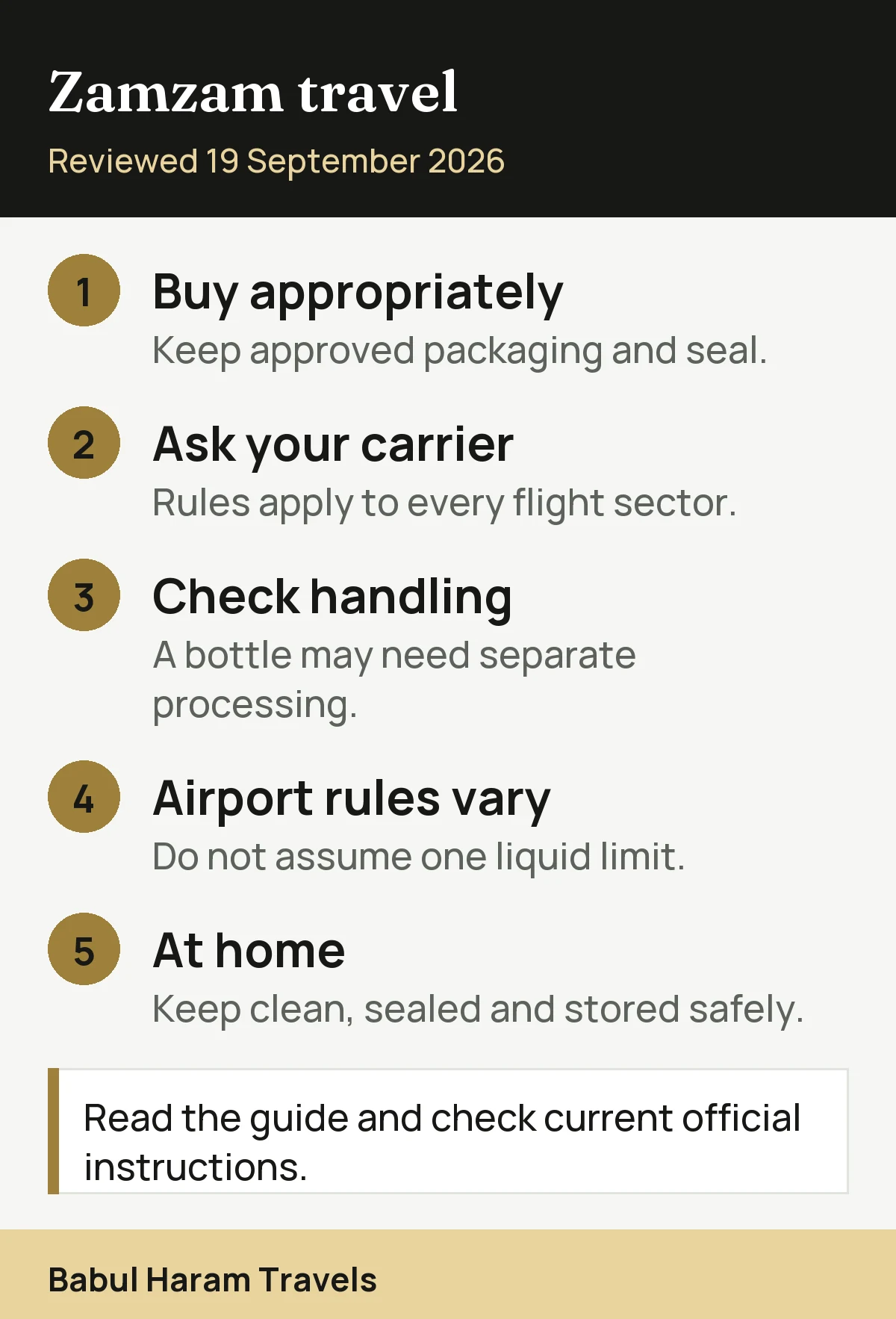
Download the Zamzam travel checklist
Babul Haram Travels produced this free checklist for UK pilgrims. It covers buying, sealing, declaring and storing Zamzam, along with the Sunnah practices for drinking it.
Save it before you travel so it stays available without mobile data, and keep this article bookmarked for the references behind each point.
Tips for bringing Zamzam home to the UK
Seven practical steps, in the order you will need them, whether you fly from London, Manchester or Birmingham.
- Buy late, not early. Purchase your sealed container close to departure so you are not moving it between hotels or cities.
- Use authorised outlets only. Official distribution points and approved retailers, never street sellers.
- Never open the seal. An intact seal is what makes it acceptable at check-in.
- Confirm your airline’s allowance. Policies differ by carrier and change; check directly rather than assuming.
- Declare it at check-in. Tell the agent you are carrying Zamzam so it is handled correctly.
- Check the required handling. A large sealed Zamzam container may need a separate airline process; departure and transfer airport liquid rules vary.
- Store it properly at home. Cool, dark, sealed between uses, and shared with intention.
Frequently asked questions about Zamzam water
What is Zamzam water?
Zamzam water is groundwater from a well inside Masjid al-Haram in Makkah, about twenty metres from the Kaaba. It has been drunk by Muslims for millennia and holds a specific status in Islam established by the Sunnah.
What does Zamzam mean?
The name is generally linked to the sense of gathering or containing, traditionally connected to Hajar’s attempt to contain the water with sand as it flowed.
Where is the well of Zamzam water located?
Inside Masjid al-Haram in Makkah, within the Mataf area near the Kaaba. The wellhead is no longer open to the public; the water is supplied through dispensers and sealed containers.
Can I bring Zamzam water back to the UK?
Often yes, if your operating airline accepts the container, packaging and quantity for every flight sector. A large bottle may need to travel separately from your normal suitcase. Check the Saudi departure and transfer rules as well as the relevant UK arrival requirements; do not assume one rule applies to every itinerary.
How much Zamzam can I bring home?
Most airlines allow one sealed container per passenger, commonly five litres, and many carry it outside the standard baggage allowance. Confirm the figure with your airline before you travel.
Is Zamzam water safe to drink?
Water supplied through the Haram dispensers and official sealed containers is treated and tested by the Saudi authorities. Buy only from authorised outlets to be sure of what you are getting.
Does Zamzam water cure illness?
The Sunnah connects Zamzam to the intention of the one drinking it. It should not be presented as a treatment for named medical conditions, and it is not a substitute for medical care.
How should Zamzam be drunk?
Say Bismillah, many face the qiblah, drink in three breaths, drink to your fill rather than sparingly, and make dua while drinking with a clear intention.
Carry the meaning, not just the container
Zamzam water connects a pilgrim in a British living room to a valley where a mother ran seven times looking for water for her child. That is the reason it is treated with care, bought properly, sealed, declared and shared.
Drink it with intention while you are there. Bring it home the right way so it arrives. And if you are still planning the journey, the Babul Haram Travels team can put together a written itinerary that includes the practical details most pilgrims only discover at the airport.
You can browse current Umrah packages, check what is involved in getting your Umrah visa from the UK, or simply ask us for a written quote with your dates and departure airport.
Editorial review: 19 September 2026. Travel rules and service availability can change; use the linked official sources for your dates. For a personal religious ruling, consult a qualified scholar.
Photo sources: Location photographs are credited under each image and are not representations of our customers, a particular hotel booking or current access routes. Featured photo: Pilatus في ويكيبيديا الإنجليزية, CC BY-SA 3.0. Resized and placed on a plain background.
Photographs retain their linked licences.