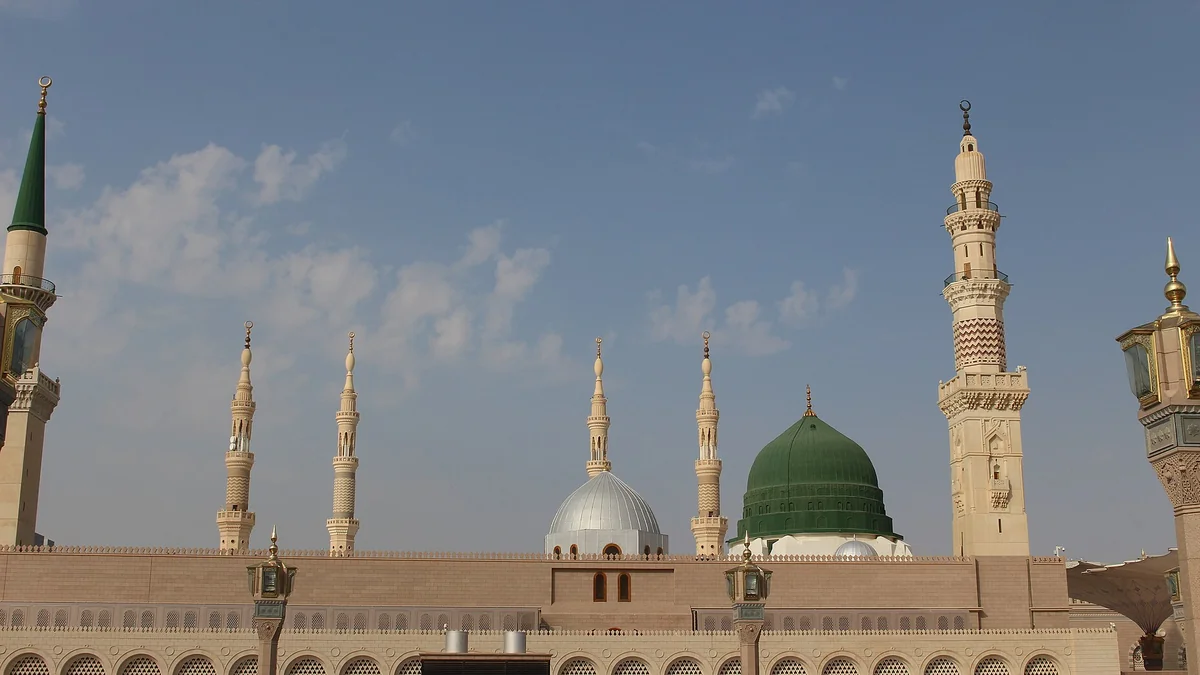
Masjid Nabawi, the Prophet’s Mosque in Madinah, is the mosque the Prophet ﷺ built and the second of the Two Holy Mosques after Masjid al-Haram in Makkah. His grave lies within it, under the Green Dome.
This guide covers why the mosque matters, how it grew, how to visit and greet the Prophet ﷺ with the right etiquette, and the practical facts UK pilgrims ask about before their Madinah nights.
Key takeaways
- Its virtue: one prayer here is better than a thousand elsewhere, except Masjid al-Haram.
- The grave: the Prophet ﷺ is buried in Aisha’s chamber, under the Green Dome.
- Etiquette: enter right foot first with the dua, pray, then greet the Prophet ﷺ quietly.
- The Rawdah: praying there needs a permit booked in the Nusuk app.
What is Masjid Nabawi?
Masjid Nabawi in Medina (Madinah), also written Masjid an-Nabawi or Masjid e Nabawi, is the mosque of the Prophet Muhammad ﷺ. Saudipedia describes it as the second of the Two Holy Mosques and the second most sacred site for Muslims after Masjid al-Haram. The Prophet’s ﷺ minbar and mihrab are inside it, and Saudipedia counts ten minarets after the Saudi expansions.
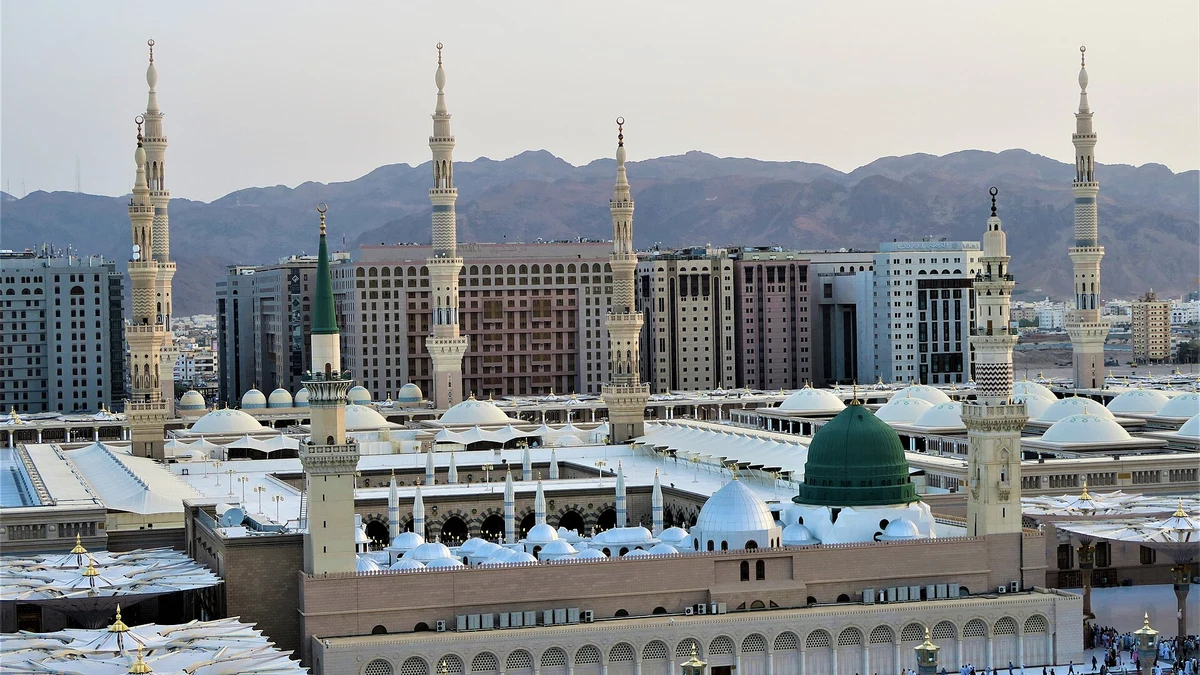
It is one of only three mosques that the Prophet ﷺ named as places to set out on a journey to: Masjid al-Haram in Makkah, his own mosque in Madinah, and Al-Aqsa in Jerusalem (Sahih al-Bukhari 1189).
Since 1977, the General Authority for the Affairs of the Two Holy Mosques has looked after the mosque and its visitors. Every one of our Umrah packages includes nights in Madinah, so you will pray here during your trip.
Why is praying in Masjid Nabawi special?
The Prophet ﷺ said that one prayer in his mosque is better than a thousand prayers in any other mosque, except Masjid al-Haram in Makkah (Sahih al-Bukhari 1190). Sahih Muslim reports the same virtue in similar words (Sahih Muslim 1394a).
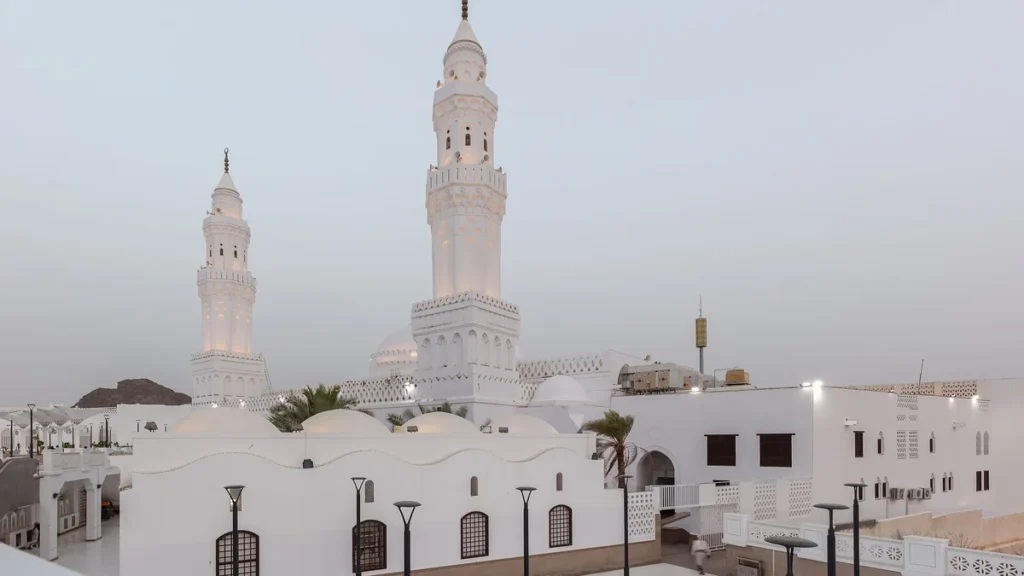
The Quran speaks of “a mosque founded on righteousness from the first day” (Quran 9:108). When Abu Sa’id al-Khudri asked the Prophet ﷺ which of the two mosques was meant, he took a handful of pebbles, threw them on the ground and said: “This is the very mosque of yours” (Sahih Muslim 1398), meaning the mosque in Madinah. Other reports link the verse to Masjid Quba, and scholars discuss both.
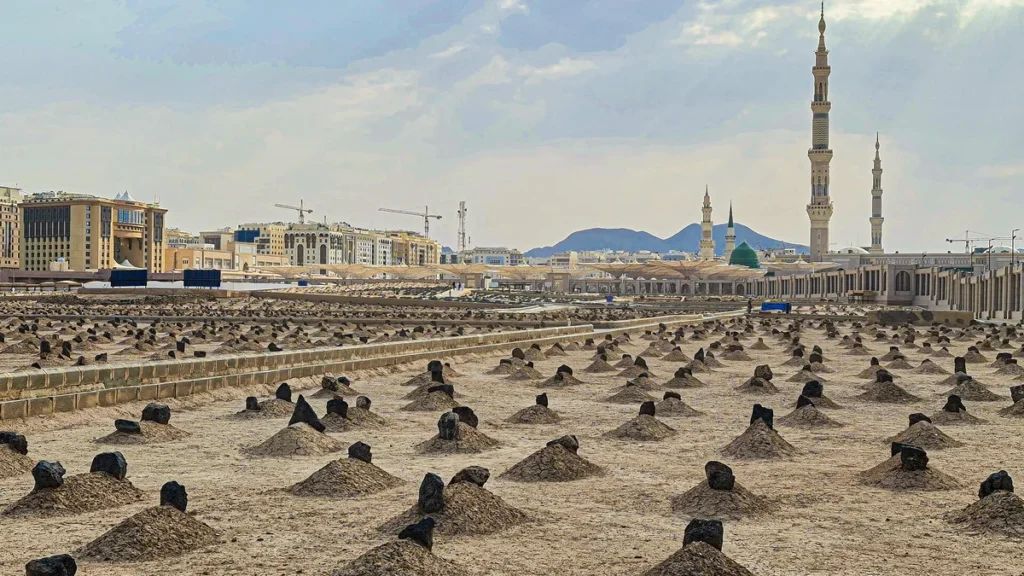
Plan your Madinah days around the five daily prayers in this mosque, with time between them for Quran, dua and rest. The al-Baqi’ cemetery lies right beside the mosque; our guide to Jannat al-Baqi explains the Sunnah of visiting it.
History: how Masjid Nabawi grew
The first mosque was a simple building put up by the Prophet ﷺ and his Companions. Almost every century since has added to it. These are the main expansions, with the dates and areas the official Saudi sources give:
| Date | Who | What changed | Source |
|---|---|---|---|
| 628 | The Prophet ﷺ, after returning from Khaybar | About 1,425 square metres added, doubling the mosque to 2,475 | Saudipedia |
| 638 | Umar ibn al-Khattab | 1,100 square metres added | Saudipedia |
| 649–650 | Uthman ibn Affan | 496 square metres added | Saudipedia |
| 706–709 | The Umayyad caliph al-Walid ibn Abd al-Malik | 2,369 square metres added; the first minarets | Saudipedia |
| 1848–1860 | The Ottoman Sultan Abdulmejid | 1,293 square metres added; the last expansion before the Saudi era | Saudipedia |
| 1952–1955 | First Saudi expansion | About 16,326 square metres added; room for nearly 28,000 worshippers | Saudi Press Agency |
| 1985–1994 | Second Saudi expansion | Total area about 300,000 square metres; room for about 698,000 | Saudi Press Agency |
| From 2012 | Third Saudi expansion | Planned area 1,020,500 square metres including courtyards; room for 1.8 million | Saudipedia |
Saudipedia also lists Abbasid work between 777 and 781 and an addition by Sultan Qaitbay in 1483. The third Saudi expansion added 250 large umbrellas on the pillars of the courtyards, shading about 143,000 square metres around the mosque.
The Green Dome and the Prophet’s ﷺ grave
The Prophet ﷺ is buried in the chamber of Aisha, the Mother of the Believers, which is now inside the mosque. The Green Dome stands over that chamber (Saudipedia). Abu Bakr and Umar are buried beside him.
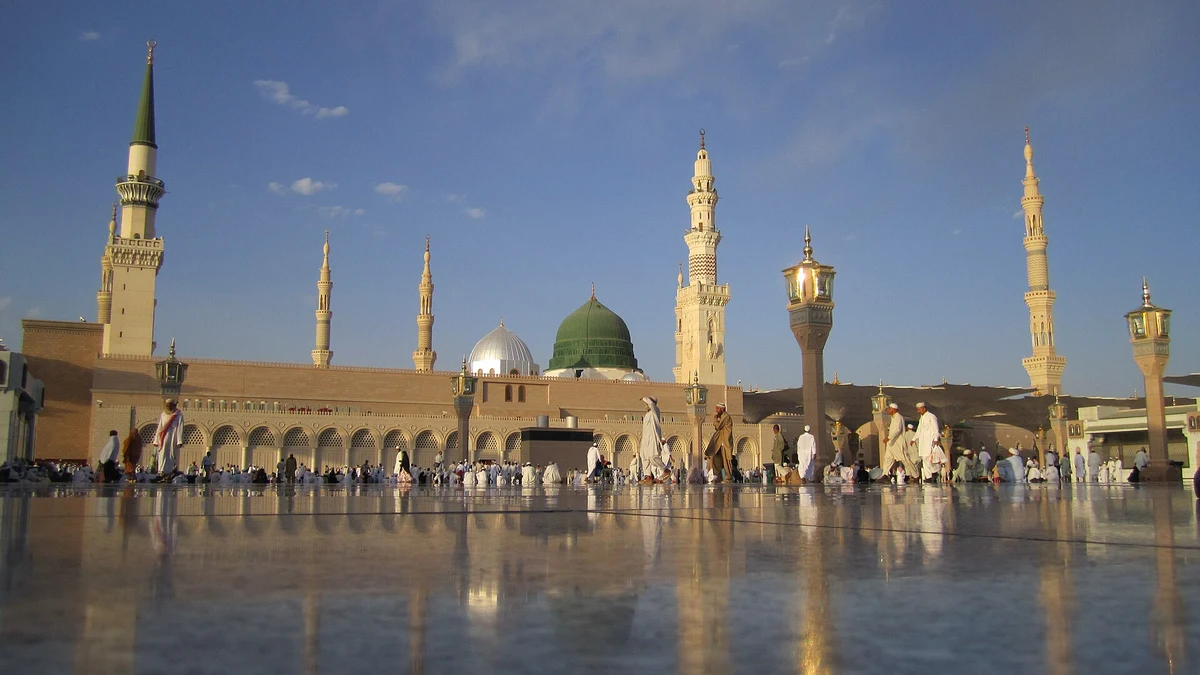
The dome does not go back to the time of the Companions. Saudipedia dates it to 1279, built of wood and covered with lead plates; IslamQA dates it to the seventh century AH, in the reign of Sultan Qalawun. It was first the colour of wood, then white, then blue. It was painted green in 1837, in the Ottoman period, and has been repainted green whenever needed since.
IslamQA’s answer also notes that scholars criticised building the dome and giving it a colour. This guide describes the history only; it does not give a ruling.
The Rawdah
The Prophet ﷺ said: “Between my house and my pulpit there is a garden of the gardens of Paradise” (Sahih al-Bukhari 1196). This area, the Rawdah, is marked inside the mosque, and praying there now needs a permit booked in the Nusuk app.
Our full guide to visiting the Rawdah in Madinah explains the permit, the time slots and the etiquette inside.
How to visit Masjid Nabawi: etiquette step by step
These steps follow the official guide of the General Authority for the Care of the Two Holy Mosques, Virtues and Etiquettes of the Prophet’s Mosque, and IslamQA.
- Enter with your right foot first and say the dua for entering a mosque:
اللَّهُمَّ افْتَحْ لِي أَبْوَابَ رَحْمَتِكَ
Transliteration: Allahummaf-tah li abwaba rahmatik.
Meaning: “O Allah! open for me the doors of Thy mercy”
Reference: Sahih Muslim 713a.
- Pray two rak’ahs as a greeting to the mosque before you sit down. The official guide calls this a Sunnah.
- Pray as much as you wish. IslamQA says it is better to pray in the Rawdah if you can (with a Nusuk permit).
- Greet the Prophet ﷺ. Stand before the grave, facing it, and greet him with respect and a lowered voice: “As-salamu ‘alayka ya Rasulallah wa rahmatullahi wa barakatuh” (peace, mercy and blessings of Allah be upon you, O Messenger of Allah). The Prophet ﷺ said that whoever greets him, Allah returns his soul to him and he returns the greeting (Sunan Abi Dawud 2041, graded Hasan).
- Greet Abu Bakr, then Umar. Move a little to your right to greet Abu Bakr as-Siddiq, then a little further to greet Umar ibn al-Khattab.
- Do not linger, touch or kiss. The official guide says not to touch or kiss the grave, not to raise your voice near it and not to stand there for long: greet, then move on.
- Leave with your left foot and say the dua for leaving a mosque:
اللَّهُمَّ إِنِّي أَسْأَلُكَ مِنْ فَضْلِكَ
Transliteration: Allahumma inni as’aluka min fadlik.
Meaning: “O Allah! I beg of Thee Thy Grace”
Reference: Sahih Muslim 713a.
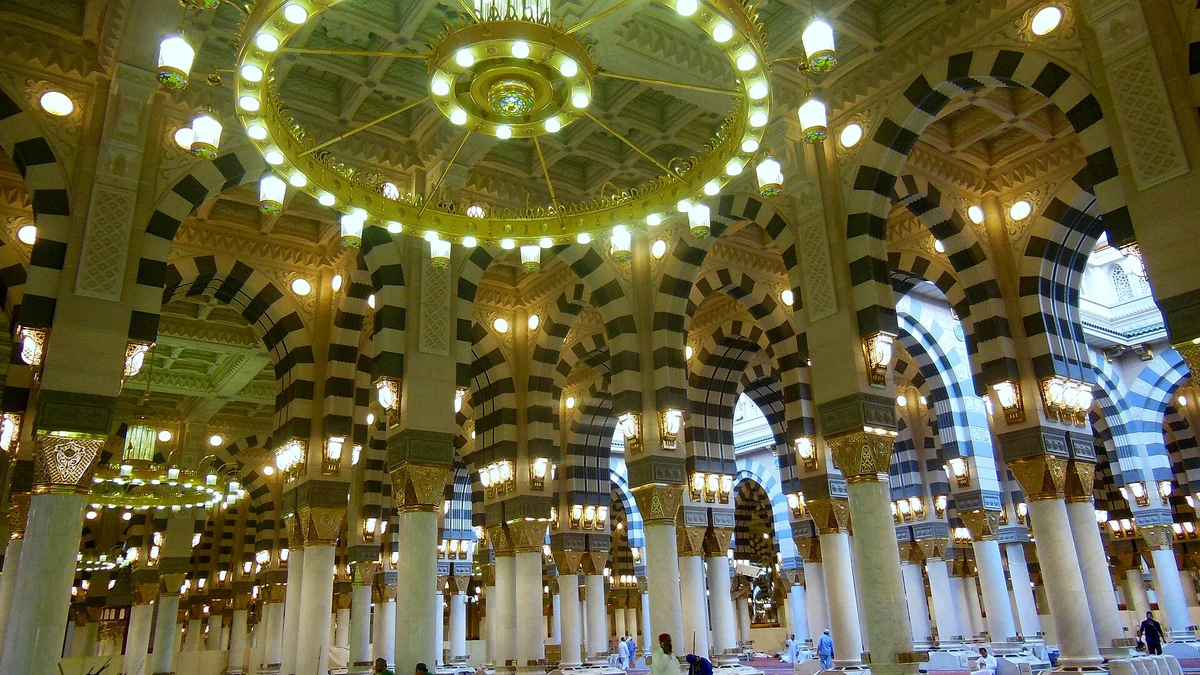
Respecting the mosque
The official guide also asks visitors to:
- keep the mosque free of arguments, loud voices, selling and announcing lost items;
- avoid being taken up with taking or watching photos and videos on a phone;
- come clean and free of strong smells such as garlic, onion, smoke and sweat;
- handle copies of the Quran with respect, and never place shoes beside them;
- for women, come in hijab and without perfume.
Intending the visit: two views
Scholars differ on what to intend when you travel to Madinah. IslamQA, quoting Shaykh Ibn Uthaymin, says to intend visiting the mosque, not the grave, because travel for worship is for the three mosques. Egypt’s Dar al-Ifta recommends intending to visit the Prophet ﷺ and drawing close to Allah by praying in his mosque. We give both views without a ruling; follow the scholar you trust.
The official guide and IslamQA also say that women do not visit the grave itself, and send their greetings on the Prophet ﷺ from wherever they are in the mosque. If you are unsure, ask a scholar you trust. For more supplications, see our duas for Umrah.
How many gates does Masjid Nabawi have?
Masjid Nabawi has 100 gates, according to the Saudi Press Agency (March 2026). The agency names among the most prominent Bab al-Salam (the Gate of Peace), Bab al-Rahmah (the Gate of Mercy), Bab Jibril (the Gate of Gabriel), Bab al-Nisa (the Gate of Women), Bab King Abdulaziz and Bab Abdulmajid.
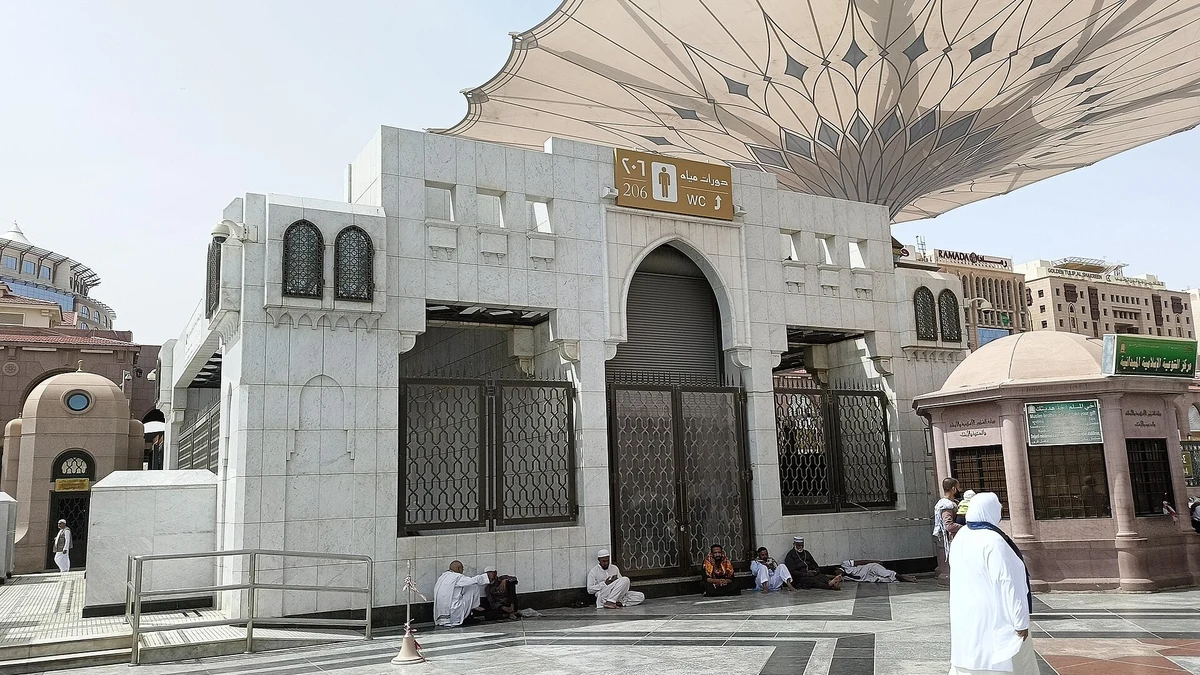
The expansion under King Fahd added seven principal entrances: three on the north side and two each on the east and west. With so many doors, agree one gate as a meeting point with your family or group before each prayer.
How big is Masjid Nabawi today?
Masjid Nabawi can hold around 1.8 to 2 million worshippers. The Saudi Press Agency (March 2026) gives around 1.8 million after the third Saudi expansion, while Saudipedia says around two million.
With the third expansion complete, the mosque and its courtyards are planned to cover 1,020,500 square metres. For comparison, the whole mosque was about 2,475 square metres after the Prophet’s ﷺ own expansion in 628.
Planning your visit from the UK
Every package includes nights in Madinah: 3 nights on a 7-night package, 5 on a 10-night package and 7 on a 14-night package. That gives you time to pray in Masjid Nabawi, book the Rawdah and visit the city.
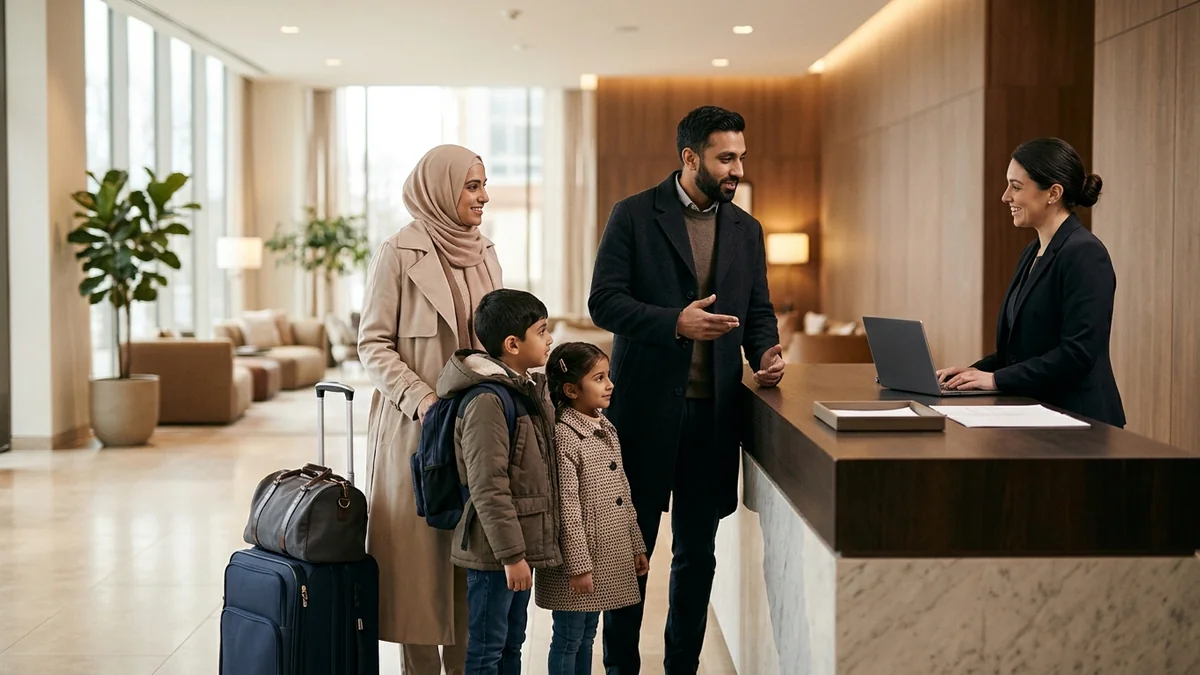
Guided ziyarat is included in our packages, and your written quote lists the sites; our guide to places to visit in Madinah describes them. Every package also has a group guide or scholar who helps with the rites.
Inside the mosque, a library is open to all visitors, with halls for men, women and children (Saudipedia). In the Prophet’s Mosque, men and women pray in separate areas with a barrier between them, as the official guide notes.
Each package also has hotel nights in Makkah for your Umrah. Our guides explain the Makkah to Madinah train and how to perform Umrah step by step. If you want a hotel closer to the mosque, compare our 4-star Umrah packages; each package names its hotels.
Questions about Masjid Nabawi
How many people can pray in Masjid Nabawi?
Around 1.8 to 2 million. The Saudi Press Agency (March 2026) puts the capacity at around 1.8 million after the third Saudi expansion; Saudipedia says around two million worshippers.
Where is the Prophet’s ﷺ grave?
Inside the mosque, in the chamber of Aisha, under the Green Dome. Abu Bakr and Umar are buried beside him. Visitors greet the Prophet ﷺ standing in front of the chamber, quietly and without touching it, then greet his two Companions.
Is Masjid Nabawi the mosque “founded on piety”?
Quran 9:108 speaks of a mosque founded on righteousness. In Sahih Muslim 1398, the Prophet ﷺ said of it, “This is the very mosque of yours”, meaning his mosque in Madinah. Other reports link the verse to Masjid Quba, and scholars discuss both.
Do I need a permit to pray in the Rawdah?
Yes. Prayer in the Rawdah is booked by time slot in the Nusuk app. The rest of the mosque needs no permit. Our Rawdah guide explains how to book.
What do I say when I enter Masjid Nabawi?
Enter with your right foot first and say “Allahummaf-tah li abwaba rahmatik”: O Allah, open for me the doors of Your mercy. This is the dua for entering any mosque, taught by the Prophet ﷺ (Sahih Muslim 713a).
Your next step
Masjid Nabawi rewards every prayer you make there. Enter with the dua, pray, greet the Prophet ﷺ quietly and respectfully, and book your Rawdah slot in Nusuk early in your stay.
Planning your Umrah from the UK? Send us your dates and ask for a written quote on WhatsApp, with every cost itemised, or compare our Umrah packages first.
Reviewed by Babul Haram Travels team · editorial review 24 November 2026. Official pages checked on 24 November 2026. For a personal religious ruling, consult a qualified scholar.
Hadith from Sahih al-Bukhari and Sahih Muslim carry no separate grade on sunnah.com; the Sunan Abi Dawud hadith shows the grade given there. Figures differ between official sources, so we give both with their dates.
Photo sources: Location photographs are credited under each image and do not show our customers. Featured photo: the Green Dome and minarets of the Prophet’s Mosque (photographed 2025), resized and cropped for this guide; photo by TheHadiRahim, CC0. The hotel picture is an illustration made with AI.